The Digital Hopscotch of 1998
The cursor hovered over the tiny, blinking arrow at the bottom of the screen. It wasn’t a sleek, modern button; it was often just text saying “Next” or an ugly GIF of a neon arrow pointing right. To click it felt like flipping a switch on a mystery box. You had spent twenty minutes reading about competitive eating or obscure 80s synth-pop bands, and now you were about to be thrust into the unknown. Would it stay on topic? Or would you accidentally stumble onto a page dedicated exclusively to hamster cages in Ohio?
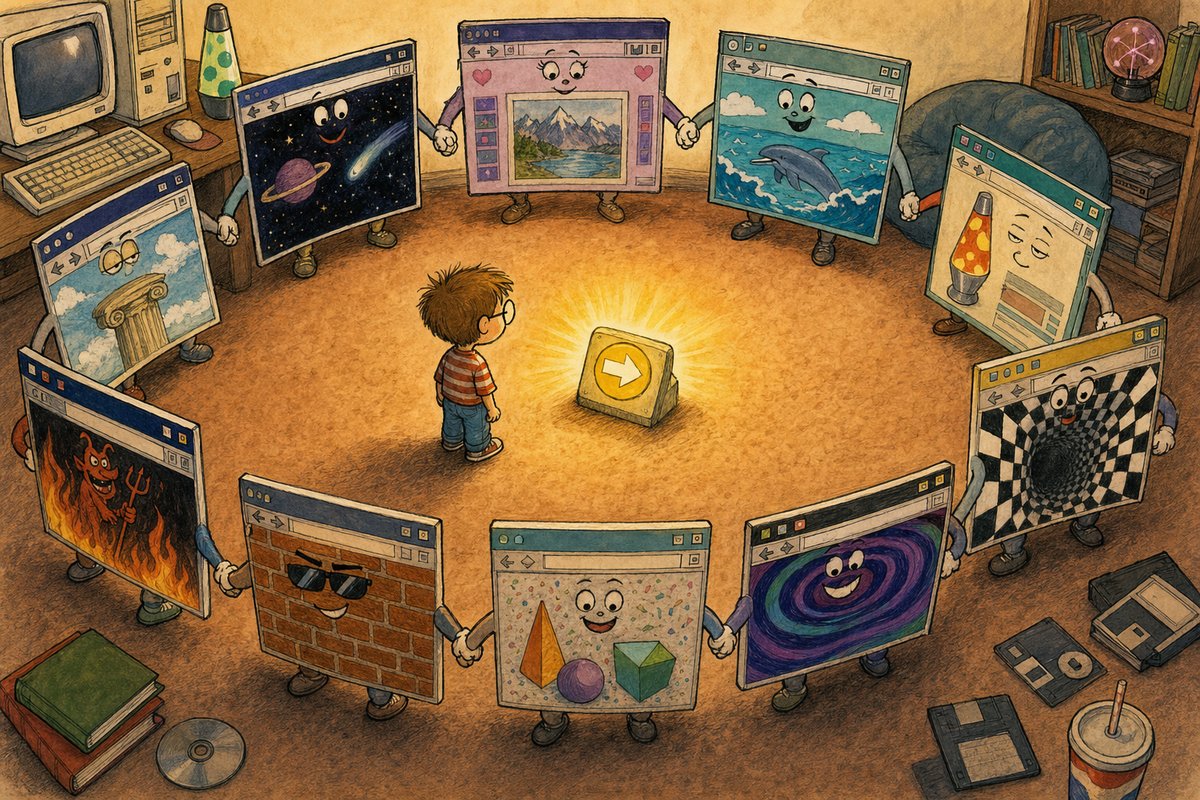
One-panel evidence: before algorithms, websites held hands and passed you to the next person who loved the same obscure thing.
The ritual was precise and required focus:
- Find the “Webring” bar stuck to the bottom of your favorite niche site.
- Click “Next” with hopeful anticipation.
- Wait for the agonizingly slow dial-up handshake.
- Gasp when a completely new world loads on your screen.
Here is what we thought: that clicking through these links was like walking down a hallway in a giant, messy house where every room belonged to a different eccentric cousin. We believed there was a secret society of webmasters who had secretly agreed to link their sites together, creating a hidden network of knowledge that Google didn’t know about yet. We felt special, like explorers charting territory before the maps were drawn. If you found a site through a webring, it felt organic, personal, and curated by hand. It wasn’t an algorithm guessing what you might like based on cookies; it was a friend saying, “Hey, check out this guy who likes the same weird stuff as me.”
   [Prev] -- (Ring Name) -- [Next]
        ^           ^           ^
        |           |           |
     Your Site  The Hub      Next Victim
        |           |           |
        v           v           v
   "Cool!"    "Who is this?" "Wait, what?"
Here is what was really happening: webrings connected independently owned pages through next/previous links and a shared directory or ring identifier. A central webmaster maintained a list of URLs that had applied to join the specific theme group. When you clicked “Next,” your browser fetched the current site’s page, read the HTML code for the link destination, and sent you to the next address on that pre-approved list. There was no magic data tracking you; there was just a static list of friends’ websites passing the baton.
The best part was the serendipity. One minute you were looking at a page about vintage calculators, and three clicks later, you were deep in a sub-basement site dedicated to collecting bottle caps. The quality varied wildly - some sites had beautiful graphics, others looked like they were built in Notepad during lunch break - but the connection felt genuine. You weren’t being sold anything; you were just wandering.
It is strange how much we miss that sense of discovery. Today, algorithms feed us what they think we want, creating a comfortable bubble of relevance. But back then, we liked the risk. We liked wondering if the next click would lead to brilliance or a poorly spelled poem about our cat. The webring was imperfect, slow, and often broken, but it felt like a community.
Now we have infinite choice, but sometimes I still miss the feeling of being lost in the right direction.