The Floppy That Had Been to the Gym
You remember the first time someone said:
“I have a Zip drive.”
Nobody asked what it did.
We just understood that this person had storage money.
The disk was blue, chunky, and serious. A normal floppy held 1.44 megabytes. The common early Zip disk held 100 megabytes.
That was not an upgrade. That was a zoning change.
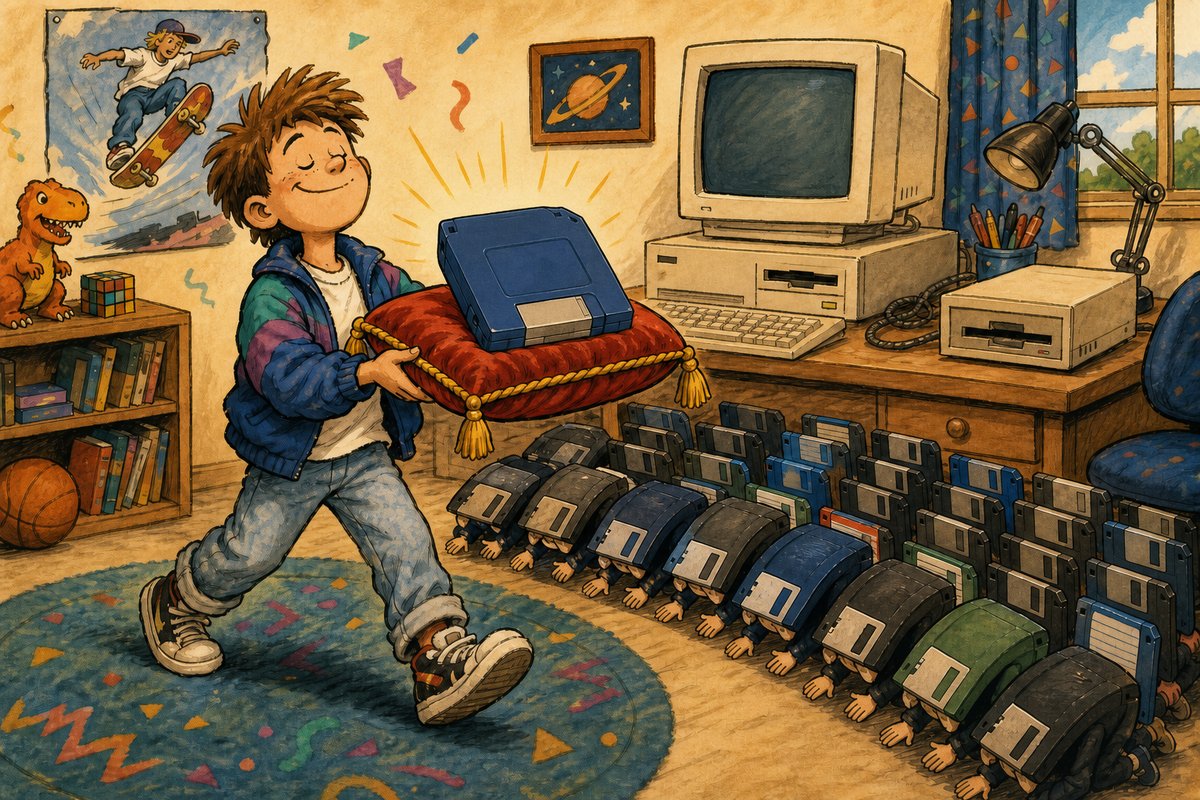
Please rise for His Royal High-Capacity Storage.
One Zip disk could hold the contents of roughly seventy ordinary high-density floppies, depending on how much rounding and emotional exaggeration your computer teacher permitted.
Suddenly you could transport:
- the entire school project
- the photos inside the school project
- the sound effect that played when the title appeared
- seventeen unrelated shareware games
- a file called
final_REAL_use_this_3.doc
It used flexible magnetic media like a floppy, but the cartridge and drive were engineered for much higher density. The drive moved its read/write heads with far more precision and spun the media faster than an ordinary floppy system.
      ordinary floppy              ZIP DISK
       ___________              _______________
      |  1.44 MB  |            /   100 MB      \
      |     o     |           |    _______      |
      |___________|           |___/_______\_____|
          "essay"               "the whole life"
The first Zip drives shipped in 1995. External versions often connected through the parallel port or SCSI, which meant the drive occupied the same neighborhood as the printer and occasionally started a custody battle over the cable.
Then there was the sound nobody wanted to discuss.
Click. Click. Click.
Some failed drives and disks developed what users called the “Click of Death”: repeated head-seeking noises followed by the realization that your one magnificent disk had become a blue coaster containing the only copy of your résumé.
Today, a single phone photo can be larger than an entire Zip disk.
But the feeling remains. Every generation gets a device that promises, “This is so much space you will never fill it.”
Then we fill it with duplicate photos, mystery downloads, and final_REAL_use_this_47.