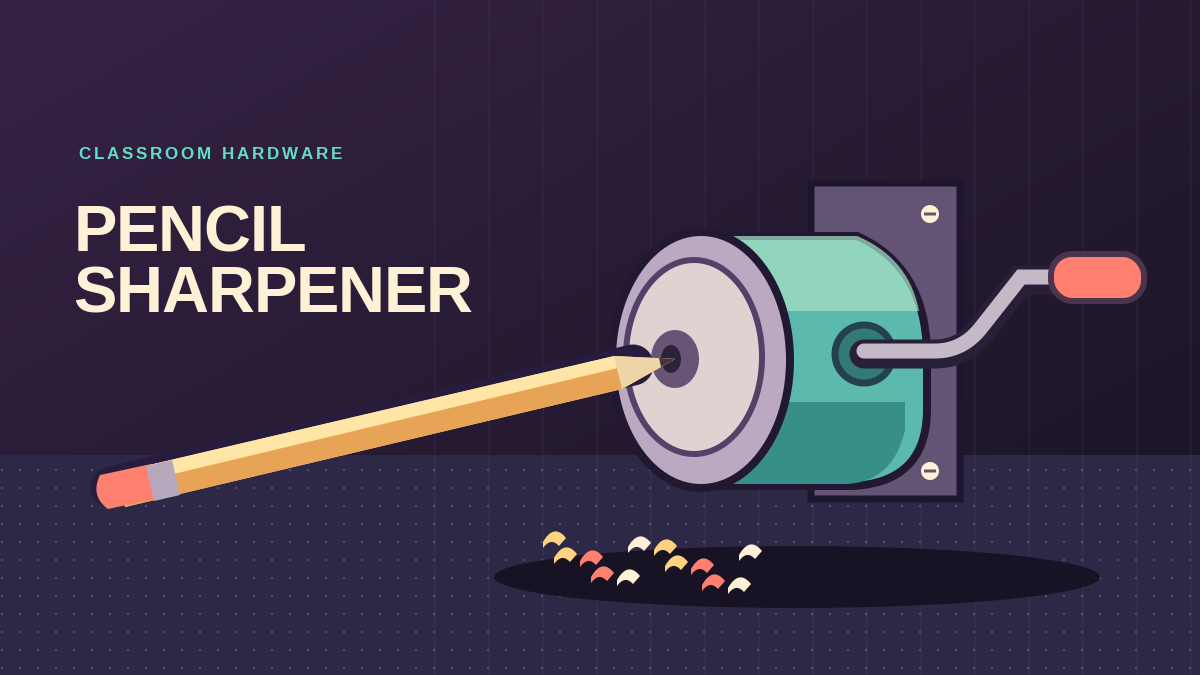
The pencil point broke at an extremely convenient time.
You could remain at your desk and face the worksheet. Or you could take an important maintenance trip to the wall, where a metal machine stood ready to make a noise that sounded like a tiny gravel truck.
This was no mere classroom supply. It was an officially sanctioned opportunity to leave your chair.
An errand with a handle
The wall sharpener made pencil ownership feel industrial. There was a crank to turn, a container accumulating evidence of the work, and often a front plate with different holes that invited serious consideration.
Selecting a hole was a technical decision. Turning the handle was labor. Examining the result was quality control.
If the point looked a little uneven, clearly another production run was necessary.
A determined operator could return to the desk with a pencil noticeably shorter than the one that had left. The machine had accomplished its purpose. Perhaps it had accomplished its purpose twelve times. Somewhere, a small tree was wondering what the emergency had been.
The machine behind the racket
The hand-cranked design remains easy to recognize. As a present-day example, Bostitch sells a manual sharpener with dual cutters, a crank, a selector for different pencil sizes, and a removable shavings tray. It can mount to a wall or tabletop.
Schools had different makes, ages, and states of repair. The familiar arrangement was a fixed machine that let your hand supply the motion.
The result of all that cranking was concrete: a point at one end and shavings somewhere else. An abstract school task briefly became a workshop job.
LONG PENCIL ---> [ CRANK CRANK ] ---> POINT
                        |
                        v
                  WOOD CONFETTI

Additional cranking: increasingly small pencil.
Even the debris had character. A neat shaving could look like a little wooden flower. A full tray looked like somebody had processed a hamster’s entire furniture collection.
The point was only half the point
An electric sharpener changes the choreography: insert pencil, hear motor, withdraw pencil. A mechanical pencil makes sharpening unnecessary altogether. Neither offers quite the same combination of a walk, a manual task, and a publicly audible productivity report.
The wall-mounted version gave a small object a whole procedure. You brought it to a station. You worked a handle. You inspected the output before returning to regular duties.
For a minute, the classroom had a manufacturing department, and you ran it.
Then the teacher looked over. The pencil was sharp. Your industrial career was over.
Back to question four, carrying a writing instrument now approximately the length of a respectable crayon.
Sources
- Bostitch Office: Manual Pencil Sharpener — a current example of the wall/desk-mounted design.