By Justin Fahmie · September 2026

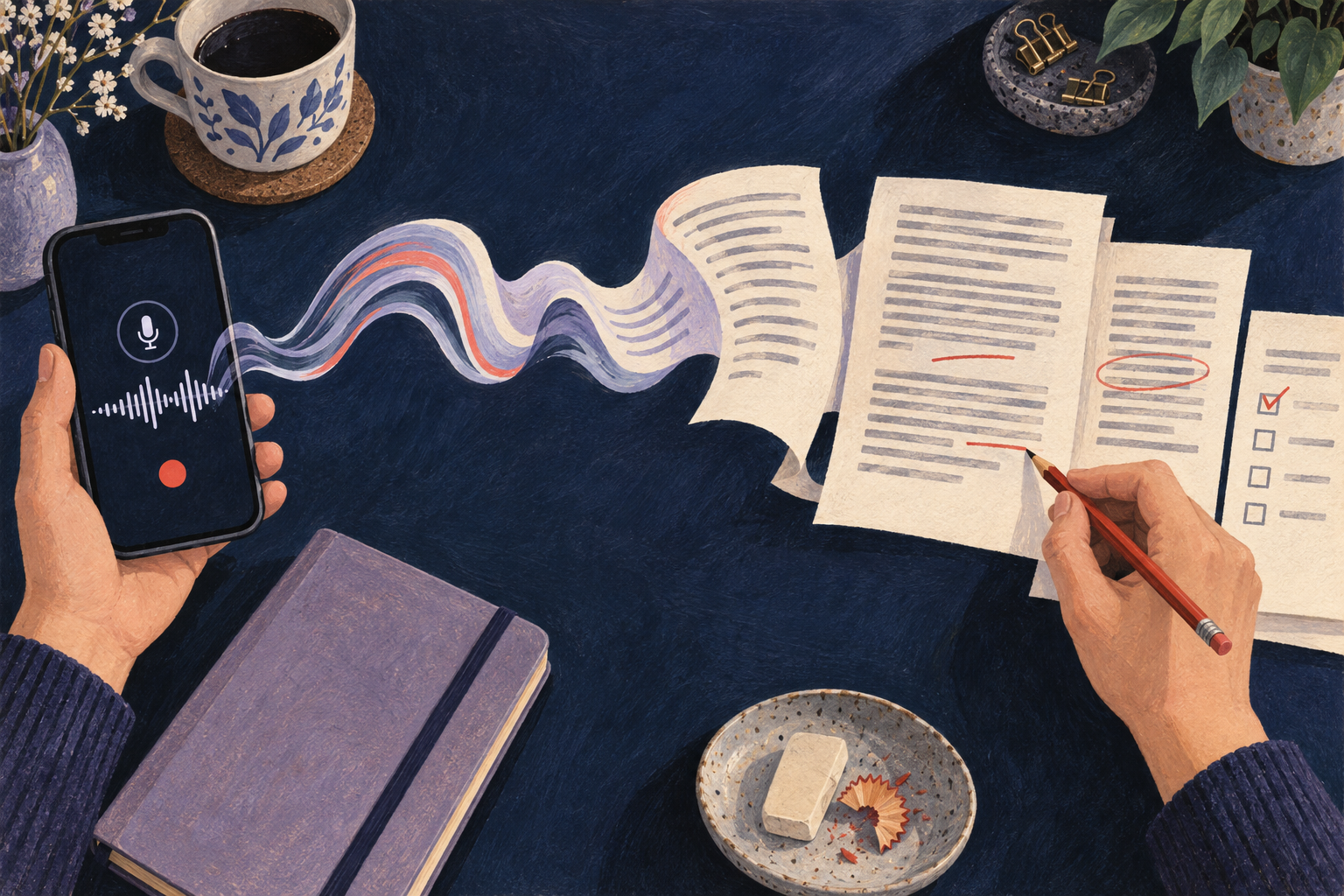
Dictation, structure, and human revision represented as a visual metaphor.
The rough version is often the only version I can get out at first.
I know the problem. I know several things about it that matter. I probably have an opinion about what caused it, another opinion about the last tool that annoyed me, and a detail that won’t turn up until halfway through explaining something else.
That is not necessarily the order a customer needs to read it in.
For a long time, getting from that pile of knowledge to a useful message was its own job. The technical work might already be understood, but it still needed sentences. Then the sentences needed rearranging. Then I had to check that I had answered the actual question instead of explaining everything adjacent to it.
With ADHD, fatigue, and migraines in the mix, that extra job can use a surprising amount of the capacity I had available for the original one.
Now a lot of my work starts with talking into my phone using Wispr. I explain the thing while I have it. I can interrupt myself, add the detail, come back to the point. Dictation gets words out where I can work with them. AI can help organize them into research, a draft, a set of steps, or documentation I might actually find useful later.
I don’t have to finish the document in my head before I begin.
That change is big enough that I’ve described the feeling as barely doing anything. It’s a strange thing to say after years of doing work the harder way. A task that used to include a lot of friction can suddenly feel suspiciously easy. Surely there’s another part where I’m supposed to struggle with it for a while.
Then I remember how much I brought to the conversation before the tool produced a paragraph.
I know the context. I know what matters to the person involved. I know which detail changes the diagnosis of a technical problem and which impressive-looking suggestion would make it worse. I have to recognize when a tool has answered a different question or turned uncertainty into confidence it hasn’t earned.
There’s plenty left for me to do.
The original “Still Building” article is a useful example. I had a history: illness, old websites, repair work, family, curiosity. AI helped arrange it into something readable. That didn’t give it permission to manufacture an exact childhood scene, decide how an outing ended, or turn every hard experience into a lesson with a tidy payoff.
And when I asked for ideas for more stories, the next useful step was a set of separate briefs. Each one had an angle. Each also needed limits on what it could honestly claim. The tool helped get the ideas into a form that another writing pass could develop. The history still had to remain mine.
That’s a lot like the work I do with customer messages and research. Organizing words is useful. Keeping the words attached to what actually happened is essential. A sentence can become smoother and less accurate at the same time. I would prefer a slightly awkward truth over a beautifully formatted guess.
The mistakes are part of using these tools. Dictation can give me the wrong word. AI can misunderstand the target, miss a qualification, or produce an answer that sounds finished before the result has been checked. I still need the source. I still need to read the draft. If something was supposed to work, I need evidence that it worked.
This is also why I care about where the result ends up. An answer disappearing into a conversation I can’t find later is only temporarily helpful. I want the useful information saved in a form I can return to. The next version of me who needs it should not have to reconstruct today’s whole train of thought.
There’s something quietly generous about making a tool do the part that costs you the most unnecessary effort. It leaves more room for the part you wanted to do: understand the problem, make something useful, get the message across.
It also leaves room to stop. Every saved minute doesn’t need another assignment. Sometimes making work easier means there’s a little more of the day left for life.
I’m still responsible for what I make. I still have to decide whether it’s right.
But I can begin with the rough version now.
For somebody with no shortage of ideas and a fairly unreliable supply of energy, that is a hell of a useful place to start.
Source and edition note
Based on Still Building, chapters 9, 12, 16, and the referenced conversation’s actual request for eight article briefs. The memoir/brief workflow is the concrete example. General mistake patterns are described without inventing a specific client incident or product guarantee.
Written with AI assistance in Justin’s requested voice from his shared history and the original Still Building memoir. Reflective prose is a reconstruction, not a verbatim interview. The illustration is an artistic interpretation; people, objects, rooms, and settings are not exact documentary depictions.