By Justin Fahmie · September 2026

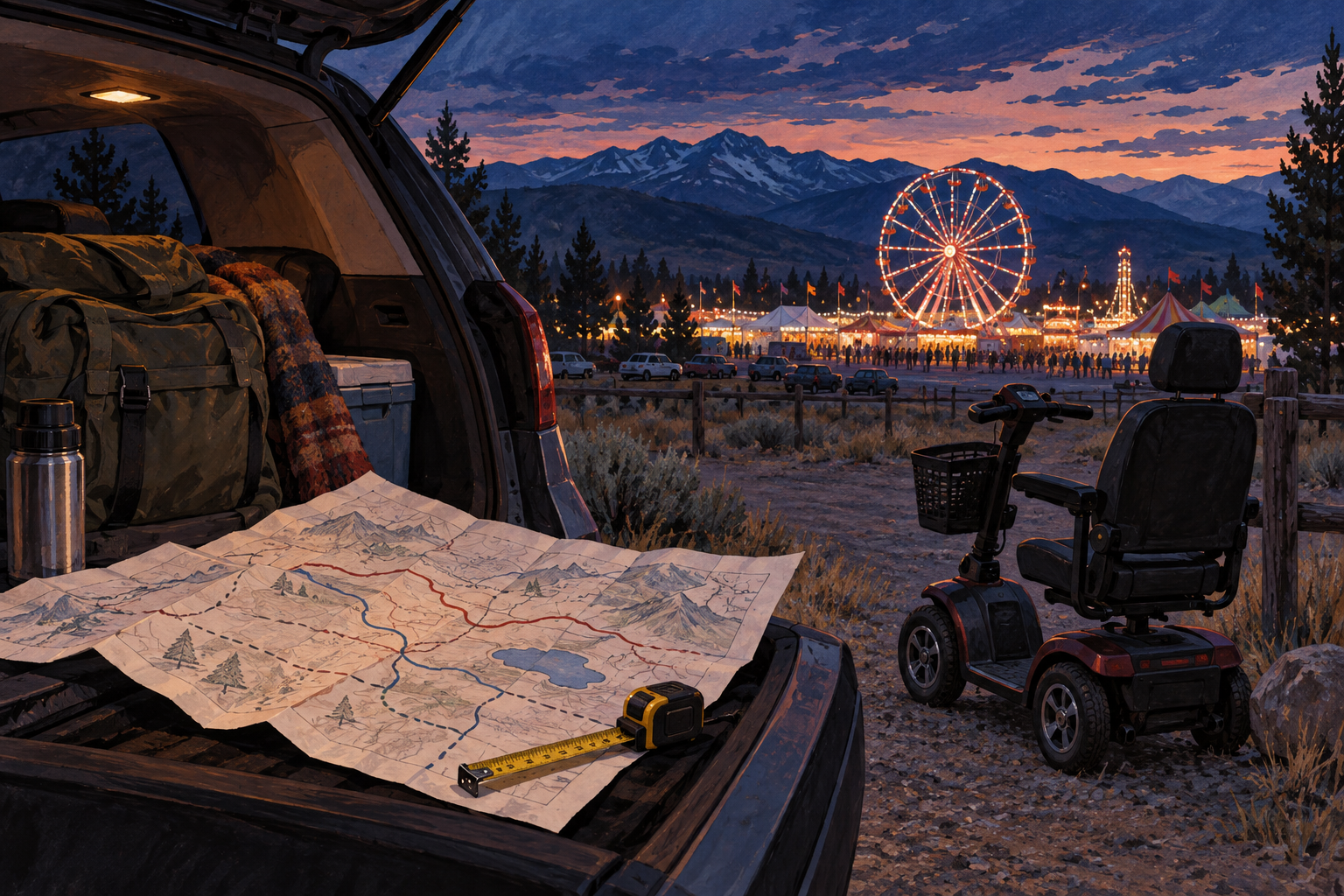
A symbolic planning scene. The landscape is imagined, not the actual Colorado State Fair grounds; it does not depict a completed outing.
The Ferris wheel was the simple part.
I wanted to go on it with Michael at the Colorado State Fair. I’m his dad. There was a thing we could do together. That was the entire original project description.
Then I had to work out how to get myself around the fair.
How much walking would it take? How much standing? Could a scooter make it workable? Was one available? Would it fit in the trunk? Could Shelly and I handle moving it? Would it work on the ground we actually had to cross?
At some point, wanting to spend time with my son had developed a transportation department.
I understand equipment research. It’s a large part of what I do. Give me requirements and I’ll start looking at what fits them. But this was a reminder that being good at figuring things out doesn’t make it pleasant to have to figure out everything. Sometimes I would like an ordinary activity to retain its ordinary size.
A scooter that looks useful on a product page still has to be available. One purchase option sold out. Local availability became another problem. The question kept moving. First it was what would help. Then it was what I could actually get. Then whether the thing I could get would create a different problem before we reached the fair.
All of that was work, even though none of it was the outing.
I can stand. I can walk. Those statements tell you remarkably little about whether I can comfortably spend hours moving around an event. They don’t tell you how I’ll feel halfway through, what the walk back will cost, or how much useful energy I’ll have left for being with my family.
The equipment question starts making more sense when you include the whole day.
I wasn’t researching a scooter because I had lost interest in moving. I was researching one because I wanted to go somewhere. There’s a fairly direct relationship between those two things. A tool that reduces the cost of getting around can leave more of me available for the reason I left the house.
Michael is that reason in this story.
I don’t need to turn him into an inspirational child in an article about his dad. I wanted to do something with my son. He gets to be a kid who goes to the fair, with his own thoughts about it. He doesn’t need an assigned role in a lesson about my health.
And Shelly doesn’t need to become a piece of equipment in the plan either. Whether we could move a scooter was a real question involving both of us. A plan that quietly hands somebody else an impossible physical task isn’t much of a solution.
That’s what makes accessibility so practical. It lives in weights, distances, surfaces, transport, timing, and the people who have to make those things work together. An available seat matters. So does getting to the seat. So does getting home afterward.
I wish more of that work was visible before somebody decided an outing was simple.
There’s a temptation to finish this story at the top of the wheel, with the city below us and every logistical problem made worthwhile by the view. I haven’t established that ending in the account I’m telling here. I’m not going to add it because an article seems to want one.
The part I can tell is the distance between the wish and the practical possibility. How a father’s ordinary idea can become a search through equipment, availability, and what his body will tolerate. How much determination gets used before anything that looks like participation has even begun.
I still want tools that make those days easier. I still want the planning to lead somewhere beyond more planning.
The goal never became complicated. The route to it did.
I just wanted to ride the fucking Ferris wheel with my kid.
Source and edition note
Based on Still Building, chapter 14, and the original article brief. Whether the Ferris wheel ride occurred remains unconfirmed; the ending deliberately stays with the documented wish and planning.
Written with AI assistance in Justin’s requested voice from his shared history and the original Still Building memoir. Reflective prose is a reconstruction, not a verbatim interview. The illustration is an artistic interpretation; people, objects, rooms, and settings are not exact documentary depictions.