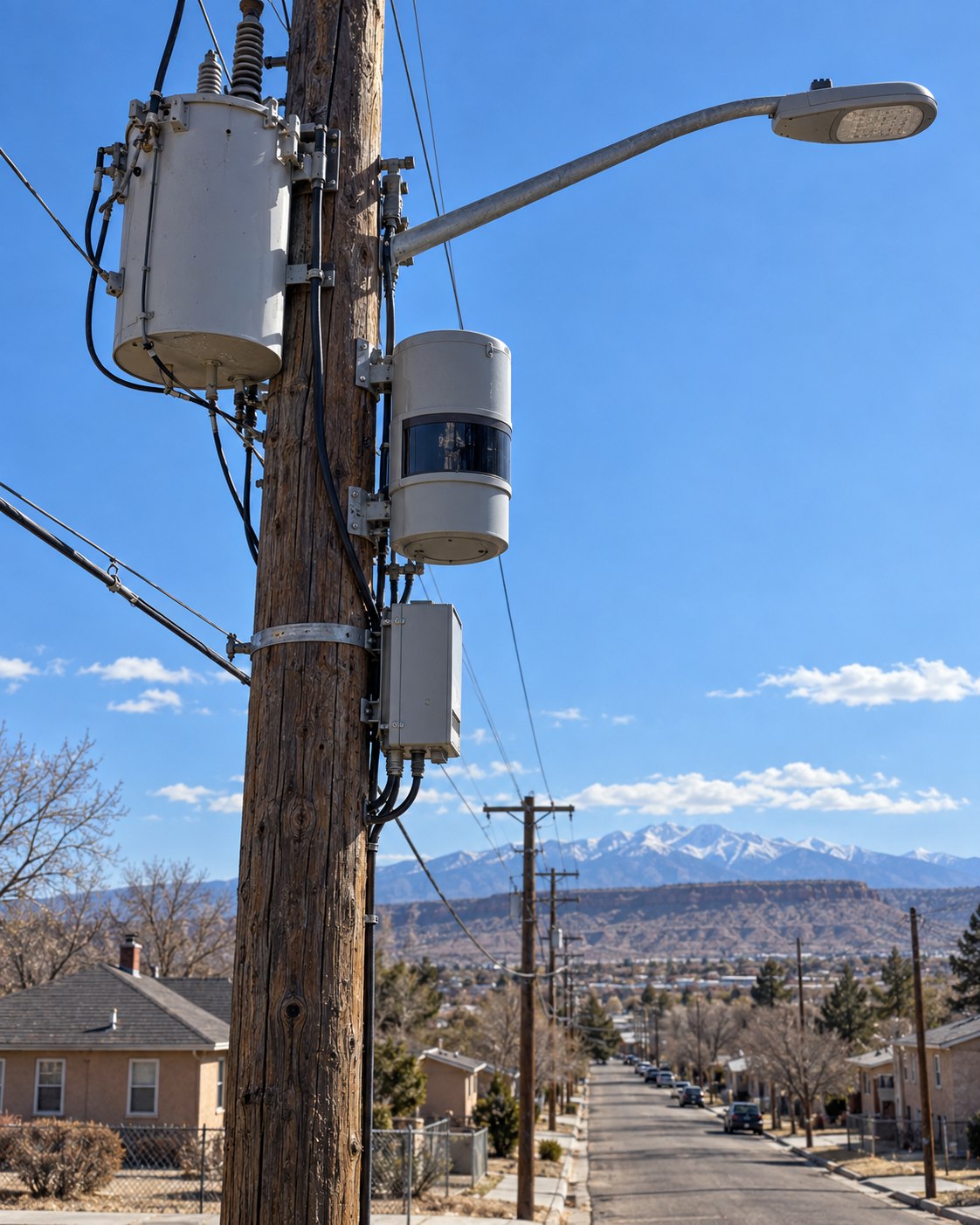
In 2017, I started noticing strange little boxes on utility and light poles around Pueblo.
They were not labeled. Some had dark panels or openings that looked like viewing windows. They appeared in more than one location, and at least one disappeared after I began asking questions. When I contacted Black Hills Energy, the company called the Prairie and Lucas device an “electric secondary voltage recorder” used “to monitor usage.” I recently recovered a screenshot preserving that exact response.
I did not believe it.
Years later, while recovering my old photographs and social-media archive, I found something that changes how seriously that suspicion should be taken: companies openly sell covert law-enforcement cameras disguised as power transformers and electrical junction boxes. One current product has the exact feature I remembered—a smoked-black band around the bottom of a transformer-shaped housing, with a pan-tilt-zoom camera concealed behind it.
That discovery does not prove the Pueblo boxes were cameras. It does prove that “a transformer would never contain a surveillance camera” is not a safe assumption.
This is what survives, what Black Hills appears to have said, what the photographs really show, and what modern covert pole-camera systems can contain.
Image note: The cover and technical cutaway in this article are labeled illustrations. The Prairie/Lucas and Acero photographs and the Black Hills reply screenshot come from my own archives. Manufacturer photographs are included for comparison and credited at the source.
The first post: two unexplained devices
On April 7, 2017, I posted this to Twitter and Instagram:
I found two of these hidden camera things on light poles in #pueblo. They are not labeled at all, wired to light pole power. Has view holes on all sides for cameras. Is this DEA? FBI?
The Twitter post still exists, and my Facebook export preserves the complete caption and date. Unfortunately, the export references an image file that Facebook did not include. The text survived; that first photograph did not.
The 2017 post matters because it establishes the observation before the later Black Hills exchange. I had seen at least two boxes, believed they had openings on multiple sides, and noticed that they were drawing power from the pole.
At that point I had no model number, owner label or confirmation from any agency. I had a visual observation and a suspicion.
Prairie and Lucas: the clearest surviving photograph
On December 14, 2018, I photographed another enclosure at Prairie Avenue and Lucas Avenue.
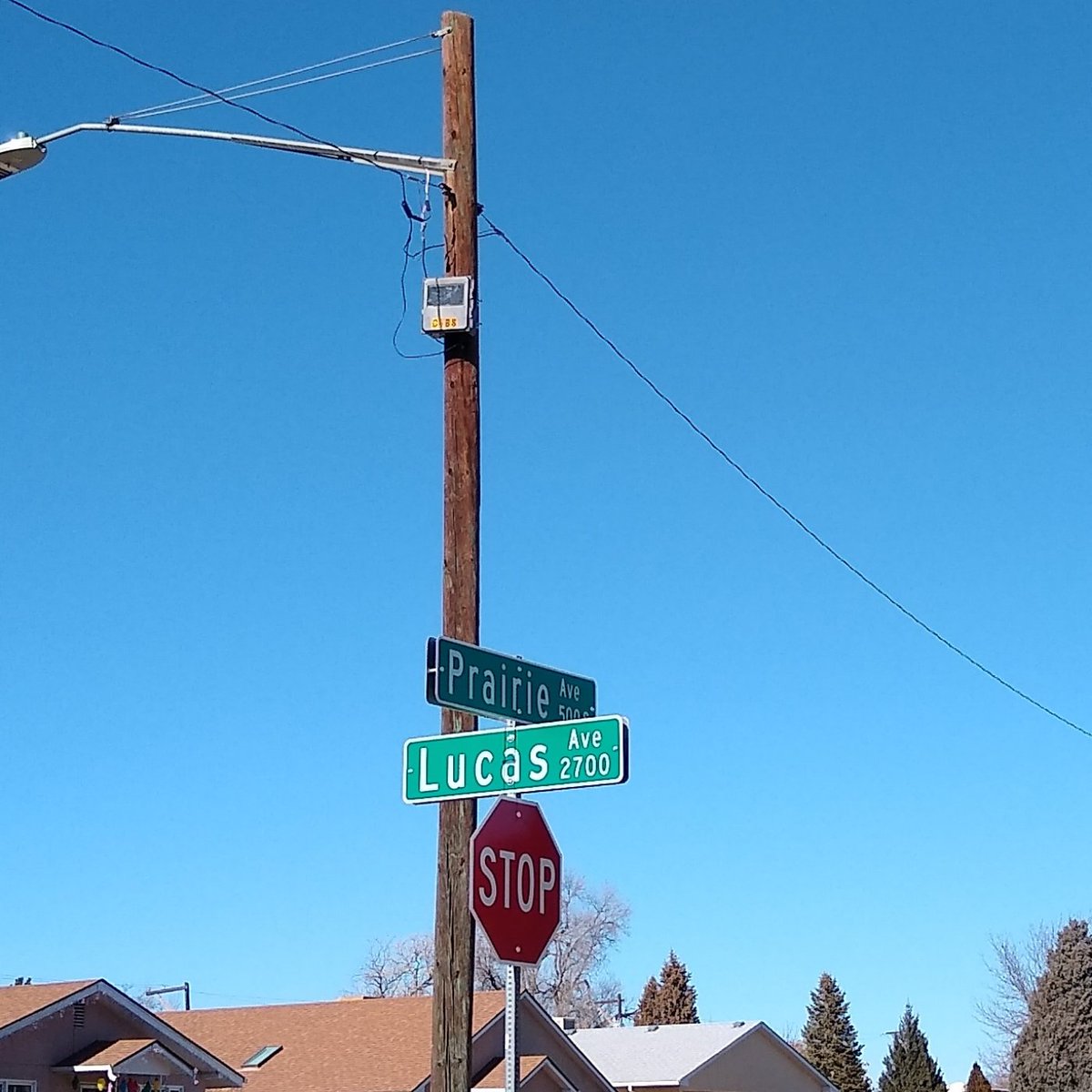
The photograph shows a pale rectangular box mounted above the street signs and below the streetlight wiring. Conductors loop into or around the enclosure. Two darker rectangular areas occupy its upper face.
I first posted the photograph with the caption:
I spy… A light pole camera. Recently added. Say hi to the feds :) #pueblo #spythespy
About an hour later, I asked Black Hills Energy directly:
Hey @bhenergy what do you refer the these boxes as? The thing that’s totally not a camera…
Black Hills replied on December 26, 2018. The original status, ID 1078047655622778880, has since been deleted—but a screenshot survived in my Facebook archive.
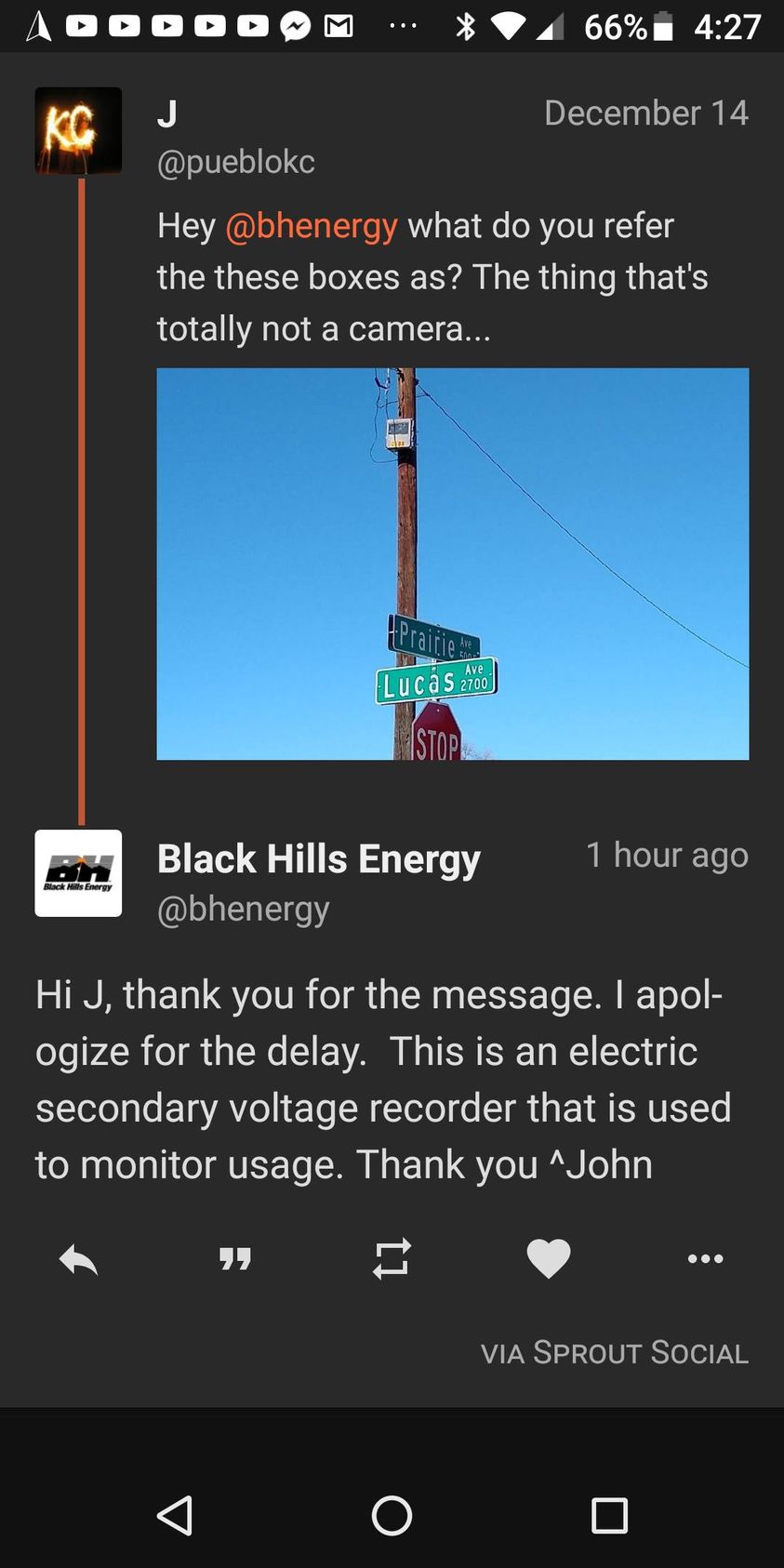
The company’s exact statement was:
Hi J, thank you for the message. I apologize for the delay. This is an electric secondary voltage recorder that is used to monitor usage. Thank you ^John
The tweet’s ID timestamps it to approximately 2:59 p.m. Mountain Time on December 26. The screenshot was captured about an hour after the reply and preserves both my original photograph and Black Hills Energy’s wording. The reply was posted through Sprout Social.
My response to Black Hills did survive:
Thanks for the reply. I’m sure you have an NDA on these. But a camera lens is clearly visible. What does that do??
My later posts shortened that explanation to secondary sensor and secondary current monitor. Those were my paraphrases. The recovered screenshot now supplies the verbatim corporate statement: electric secondary voltage recorder used to monitor usage.
The box disappeared
On February 15, 2019, I posted:
Black hills removed the spy camera they claimed was a secondary sensor. Looks like the drug house got raided too…
The sequence made me suspicious: unexplained device, company explanation, device removed, nearby law-enforcement activity.
It is also important not to manufacture certainty from timing. The surviving record does not establish when the box was installed, why it was removed, whether the nearby police action was connected, or who could access anything the device collected. Correlation made the story interesting; it did not finish the investigation.
Acero: another box below a transformer
On April 10, 2019, I photographed another installation on Acero.
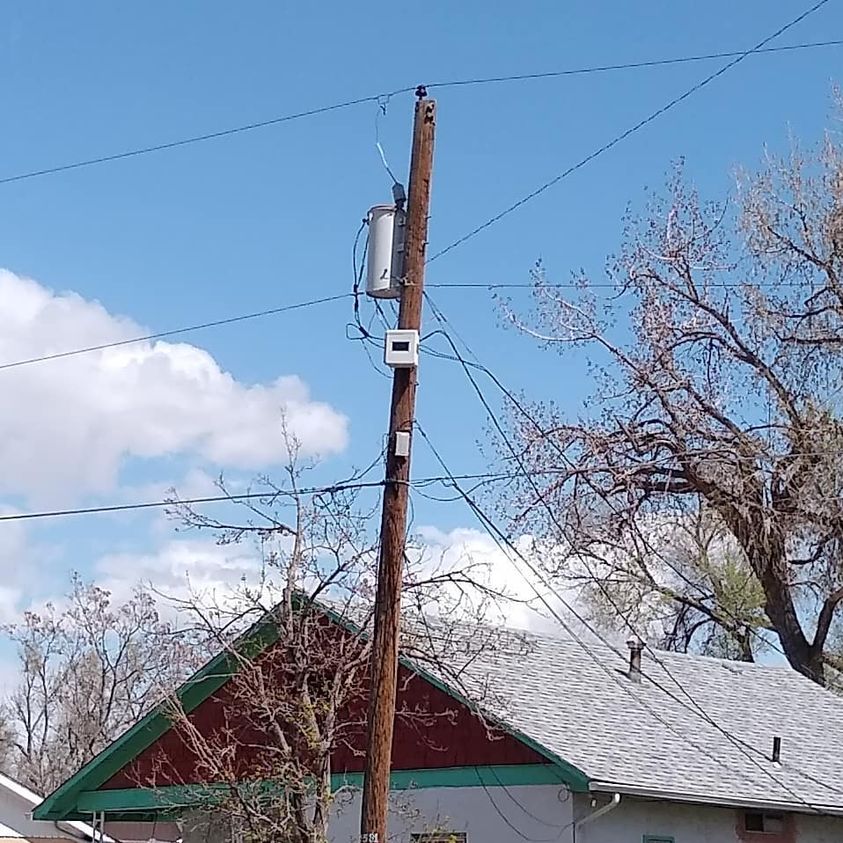
This one is visually different. A normal cylindrical distribution transformer sits near the top of the pole. Immediately below it is a separate white rectangular enclosure with a dark horizontal panel on its face. Additional wiring runs along the pole, and a second narrow component is mounted farther down.
My archived caption reads:
Found another blackhills ‘secondary current monitor’ that’s totally Not a camera. On Acero right next to today’s crime scene… Makes sense
I then asked Black Hills: “What would you call the white box under the transformer?” I have not found a surviving answer to that second question.
What the photographs prove—and what they do not
The photographs prove that unusual, externally wired enclosures were installed on Pueblo utility poles. They show dark or recessed panels that reasonably invited questions. The archive proves that I asked Black Hills about them and that I later understood the company’s explanation to involve secondary electrical monitoring.
The images do not reveal the contents.
Real electrical instruments can be temporarily attached below transformers to measure current, voltage, load and power-quality problems. A dark rectangle can be a display, an inspection window, an infrared-transparent panel or simply part of a weatherproof enclosure. Wiring toward a transformer’s secondary conductors is consistent with electrical monitoring.
But the other possibility is no longer hypothetical.
The transformer that actually is a camera
MAXSUR advertises the DTCAM-3 Covert Utility Pole Transformer Camera. It is explicitly designed to blend into electrical-distribution environments.
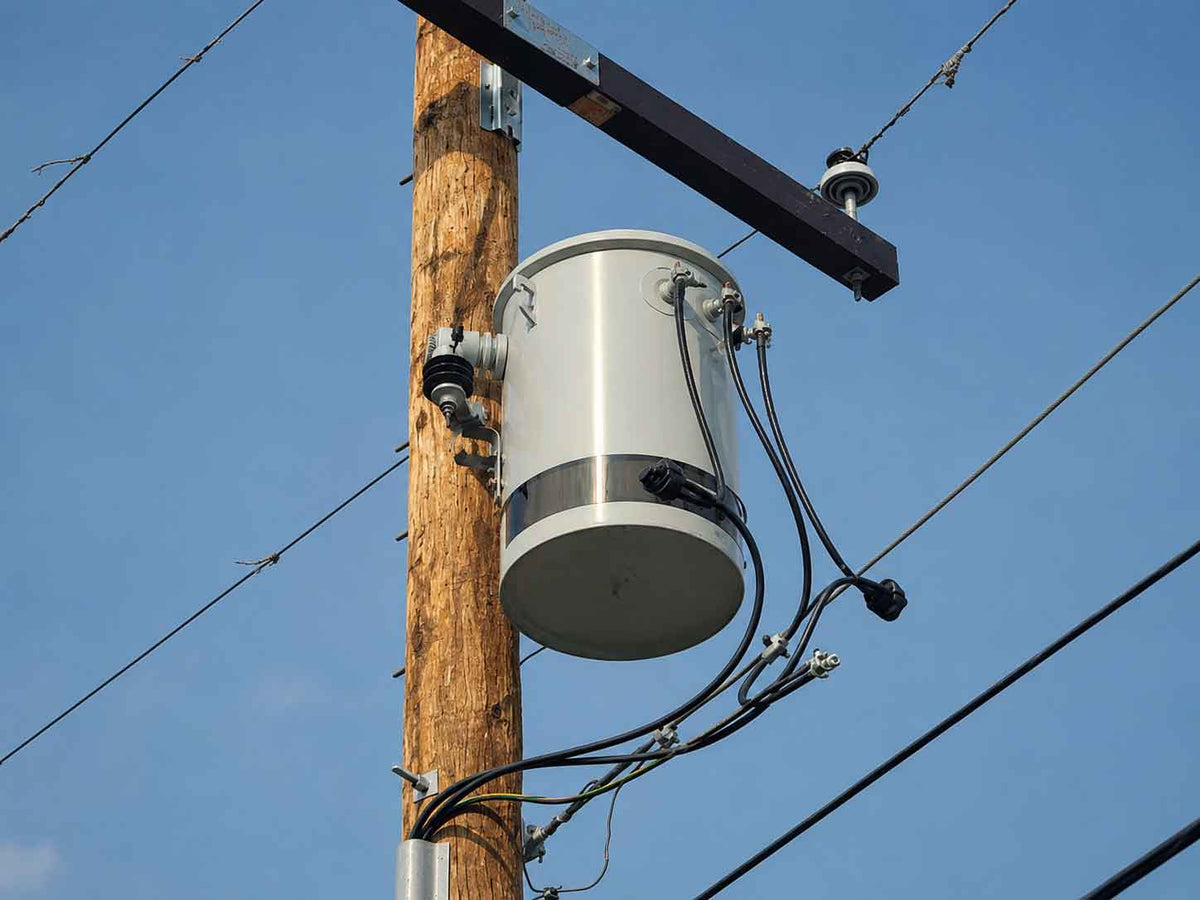
Manufacturer reference: MAXSUR DTCAM-3. The dark lower strip is described as a Lexan viewing band. This is not the Pueblo device.
The housing can contain:
- an Axis fixed or pan-tilt-zoom network camera
- optical zoom and low-light imaging
- a Microhard 5G/LTE cellular modem
- low-profile cellular and GPS antennas
- onboard recording
- AC, DC, battery or solar-assisted power
- an optional downward-looking camera
- an optional motorized actuator that changes the viewing position
The black strip is not decoration. MAXSUR calls it a Lexan viewing band: a dark continuous window that lets the camera see outward while making its exact position and direction difficult to see from the ground. The company can customize window placement, antennas, mounting, finish and internal camera package.
i2c Technologies sells another transformer-style system, the VX400 Deployable Covert Pole Camera. Its published specifications include an Axis or Verkada PTZ camera with up to 32× zoom, low-light video, optional fixed cameras covering 270 degrees, a ruggedized computer with 1 TB of local storage, and 4G/5G remote access. It can also communicate over fiber, copper, point-to-point radio or mesh networking.
The result is an entire remotely controlled surveillance station inside something most people have trained themselves not to notice.
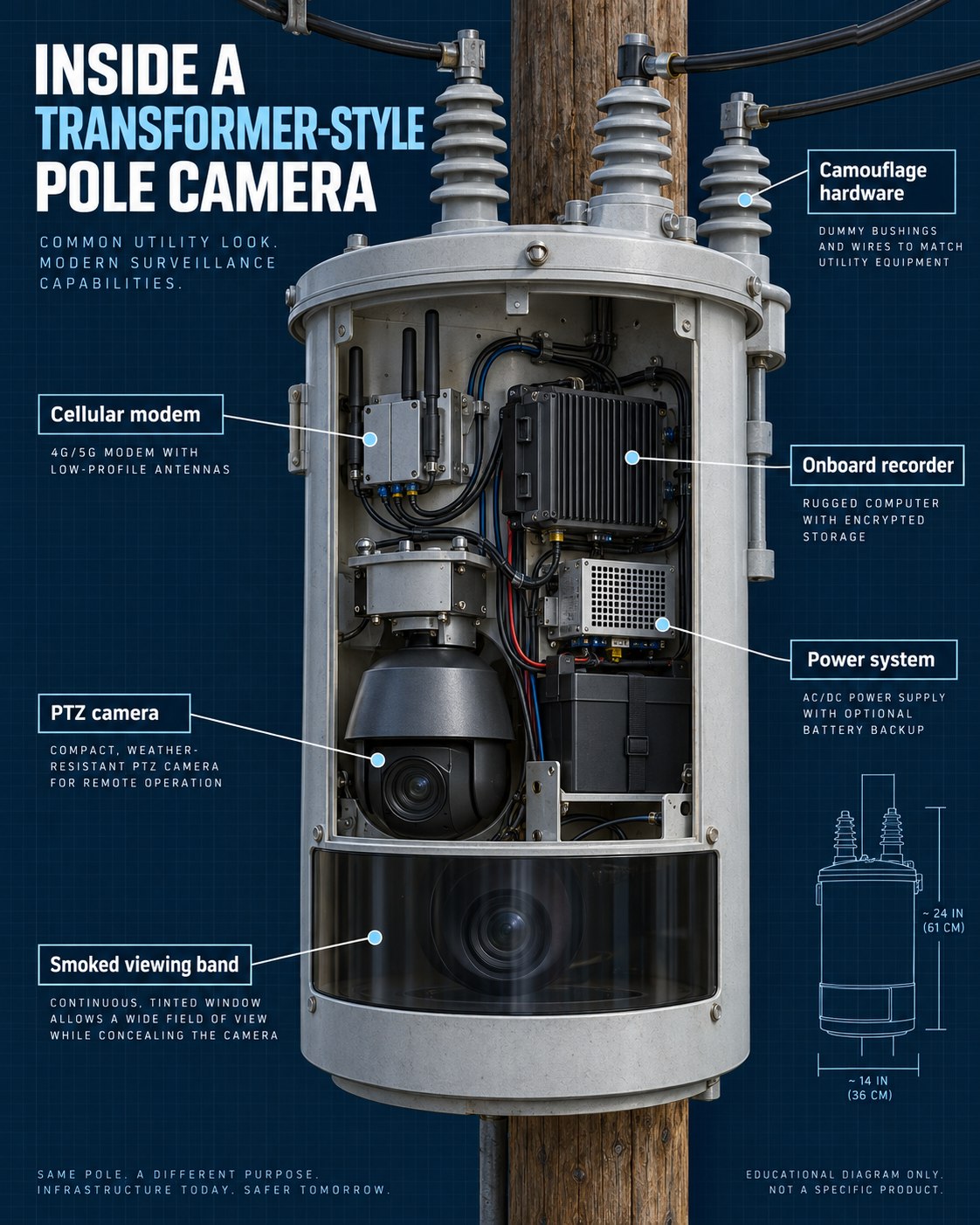
Custom educational illustration based on publicly advertised capabilities. It is not a photograph or blueprint of a particular product.
The fake high-voltage box
The disguise does not need to be round.
MAXSUR’s SV2 Covert Utility Enclosure Camera looks like a small electrical junction box. Its face carries a high-voltage warning and a dark rectangular viewing window.
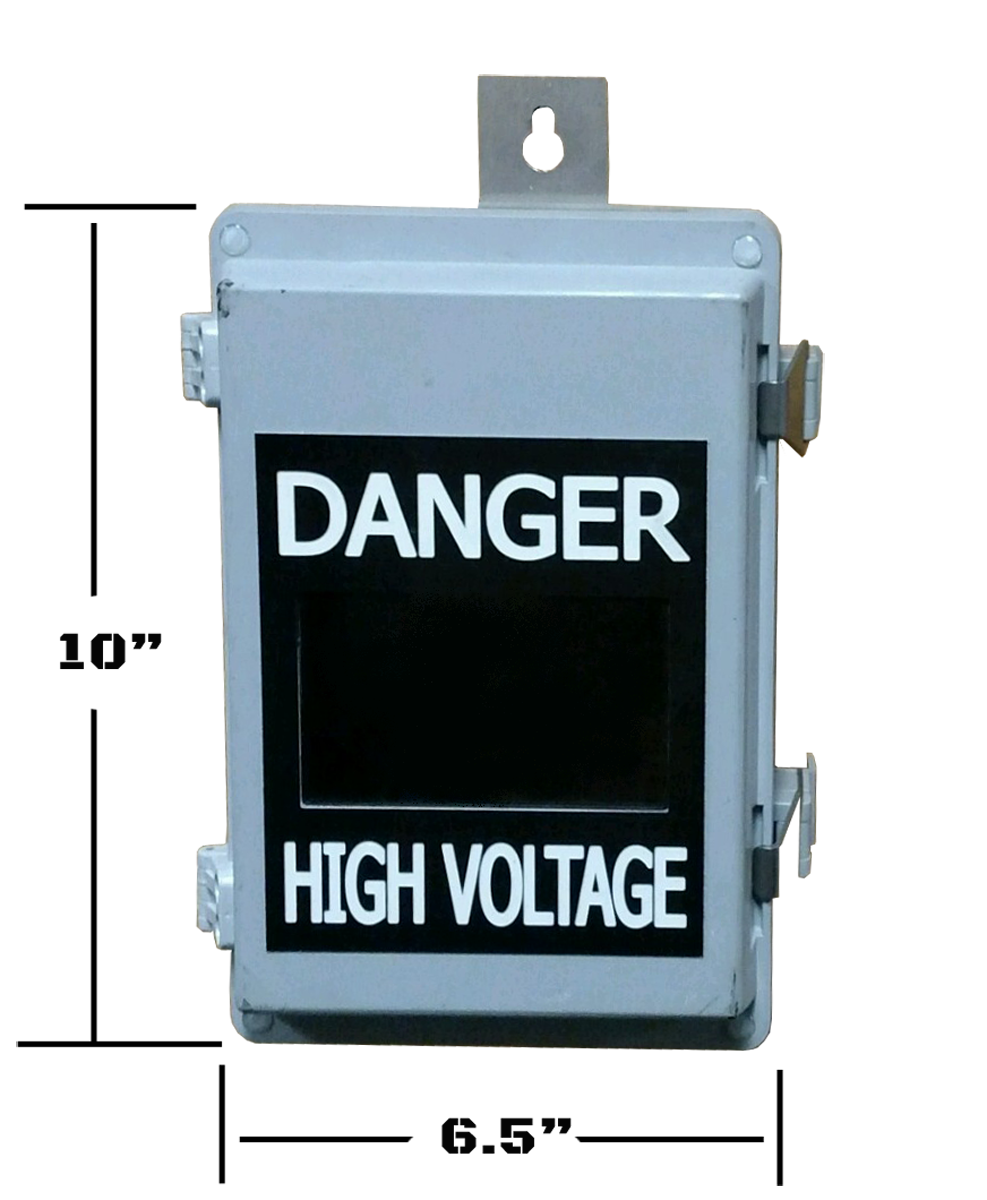
Manufacturer reference: MAXSUR SV2. This shows the concealment category, not an identification of the Acero device.
Behind that window, the manufacturer advertises an HD PTZ camera, optical zoom, low-light performance and an embedded 4G LTE modem. MAXSUR says the system weighs less than six pounds and can capture license-plate detail beyond 200 feet under suitable conditions.
That is uncomfortably close to the visual question raised by the Acero photograph: a small pale utility-style enclosure with a dark rectangular face. It is not a model match—the proportions, label and panel arrangement differ—but it demonstrates why appearance and pole wiring cannot settle the question.
Cameras that do not need pole power
Boundless Security Systems sells The Rabbit, a much smaller cellular pole camera built for law enforcement.
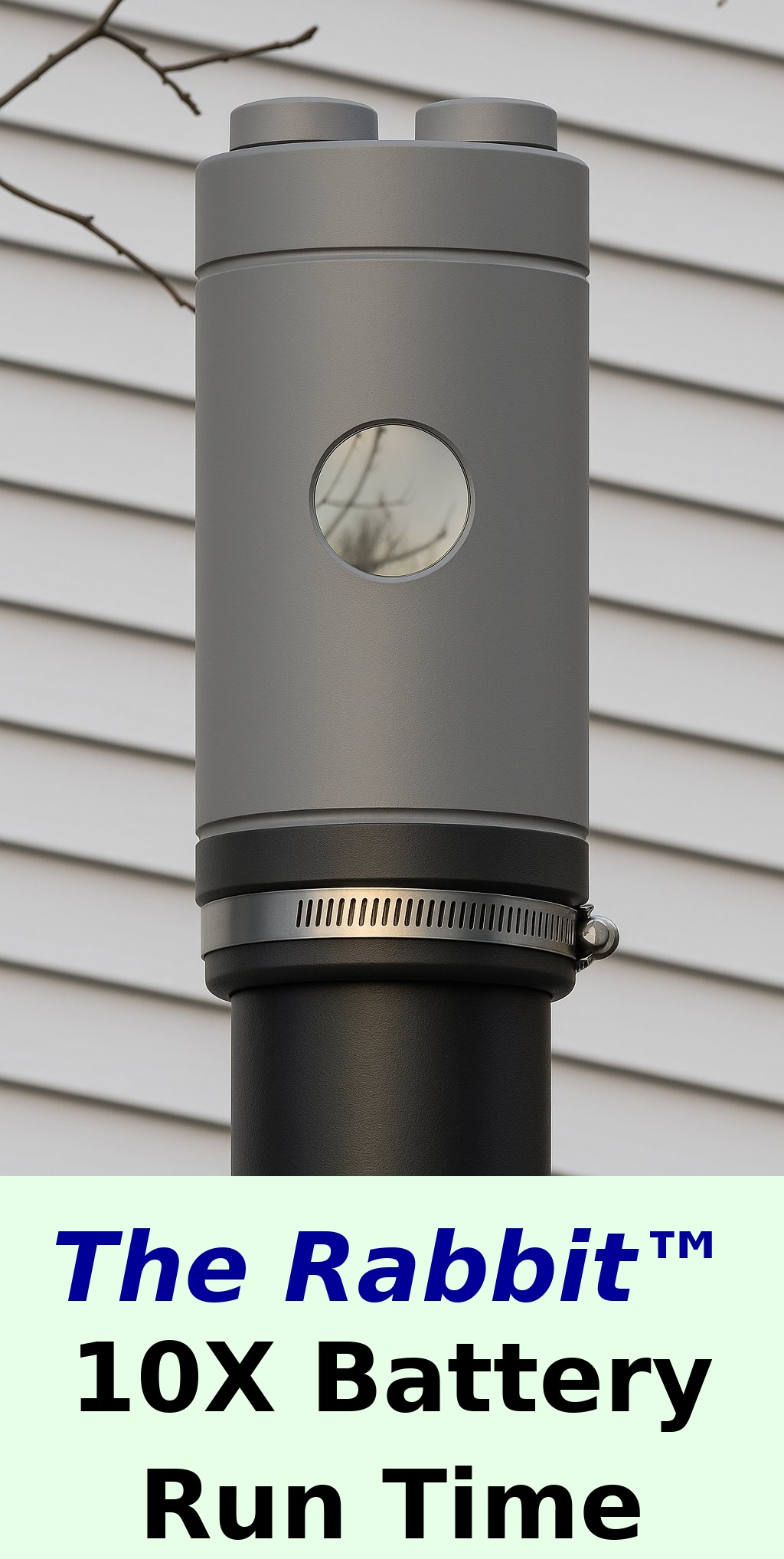
Manufacturer reference: Boundless Security Systems’ The Rabbit.
The manufacturer describes a roughly four-inch-wide, nine-inch-high unit with true PTZ control, 10× optical zoom, internal HD and time-lapse recording, cellular connectivity and battery or solar operation. It claims useful license-plate detail at distances up to 450 feet under favorable conditions.
This matters when evaluating mysterious pole equipment: the absence of a conventional power connection does not eliminate a camera. Batteries and a small solar panel can sustain a remote system, while cellular networking removes the need for a visible data cable.
WCCTV goes further in the other direction. Its page for a covert surveillance pole camera describes onboard storage, remote access, mobile connectivity and cloud-based control—but says it does not publish photographs or detailed specifications in order to protect existing users’ confidentiality.
Some of this equipment is meant to be recognizable only to the people deploying it.
This has happened on a utility pole before
The strongest public precedent I found came from Phoenix, not Pueblo.
In 2016, ABC15 investigated an unexplained box on an Arizona utility pole. The Bureau of Alcohol, Tobacco, Firearms and Explosives eventually acknowledged that the box belonged to ATF and was part of an ongoing investigation.
ATF would not say whether the box contained cameras. The local utility, Salt River Project, told ABC15 it had not known the box was installed. ATF said that security requirements could permit such measures without utility permission and maintained that it had acted within its authority.
That incident does not connect ATF—or any federal agency—to the Pueblo equipment. It establishes a narrower but important fact: federal investigators have installed undisclosed equipment on utility poles, and even the utility owning the pole may not initially know what it is.
Pole-camera surveillance can last for months
The legal record confirms how these systems are used.
In the federal prosecution of United States v. Tuggle, investigators placed three cameras on public property with views of a residence and recorded the exterior for approximately eighteen months. The government’s Supreme Court filing describes agents remotely adjusting the cameras’ pan, tilt and zoom and reviewing the resulting recordings.
That is not a product brochure. It is a documented description of prolonged pole-camera surveillance in a federal criminal investigation.
What may be inside one of these systems
Across the manufacturers reviewed here, a modern covert pole package may combine:
- one movable PTZ camera or several fixed cameras
- optical zoom powerful enough to read plates at long distances
- low-light or infrared imaging
- a rugged local computer or DVR
- weeks of onboard storage
- cellular, fiber, Wi-Fi, mesh or dedicated-radio backhaul
- GPS and low-profile antennas
- AC conversion, battery packs and solar charging
- remote health monitoring and camera control
- video-management software and automated analytics
Other pole-mounted public-safety devices can include automatic license-plate readers, acoustic gunshot sensors, traffic cameras, Bluetooth or Wi-Fi detection equipment and environmental sensors. Their presence does not automatically imply covert surveillance. It does mean “it is just a box” is not an adequate technical explanation.
Was Black Hills lying?
I called the company’s explanation a lie in my old posts. With the surviving evidence, I cannot prove that statement today.
A secondary current monitor is plausible equipment beneath a transformer. The visible wiring in the Acero photograph supports that possibility. Conversely, commercial covert cameras are deliberately built to mimic exactly that kind of infrastructure, complete with dark windows, plausible cabling and ordinary-looking electrical housings.
The recovered response lets us examine what the company actually claimed, but it still does not identify a manufacturer, model number, work order or collected dataset. “Electric secondary voltage recorder” is a technically plausible description of real utility-monitoring equipment. The photograph alone cannot show whether that description was accurate for this particular box. Black Hills may have owned the instrument, or another organization may have had permission to use its pole; the surviving record does not resolve those alternatives.
What would resolve them is straightforward documentation:
- Manufacturer and model number
- Work order and installation dates
- Electrical measurements collected
- Data retention and access policy
- Owning organization and contractor
- Reason for removal
If these were ordinary grid instruments, that information should be easy to provide without compromising anybody’s privacy. If some details were protected by an investigation, the record should eventually show who authorized the installation and under what authority.
My conclusion now
I still think the boxes deserved scrutiny.
The photographs alone cannot establish that they were cameras, much less that they belonged to the FBI, DEA or ATF. The electrical-monitoring explanation remains technically credible. The timing around nearby police activity remains correlation rather than proof.
But my underlying observation was valid: surveillance equipment can be disguised as utility infrastructure. It can look like a transformer, a high-voltage junction box or an anonymous cylinder. It can carry a PTZ camera, cellular modem, local recorder and enough optical zoom to watch activity from blocks away. Sometimes the utility may not even know it is there.
The honest answer is not “definitely a camera” or “definitely just a sensor.” The honest answer is that the available photographs leave both possibilities open—and the companies and agencies holding the records are the ones capable of closing the gap.
Until then, look up once in a while.