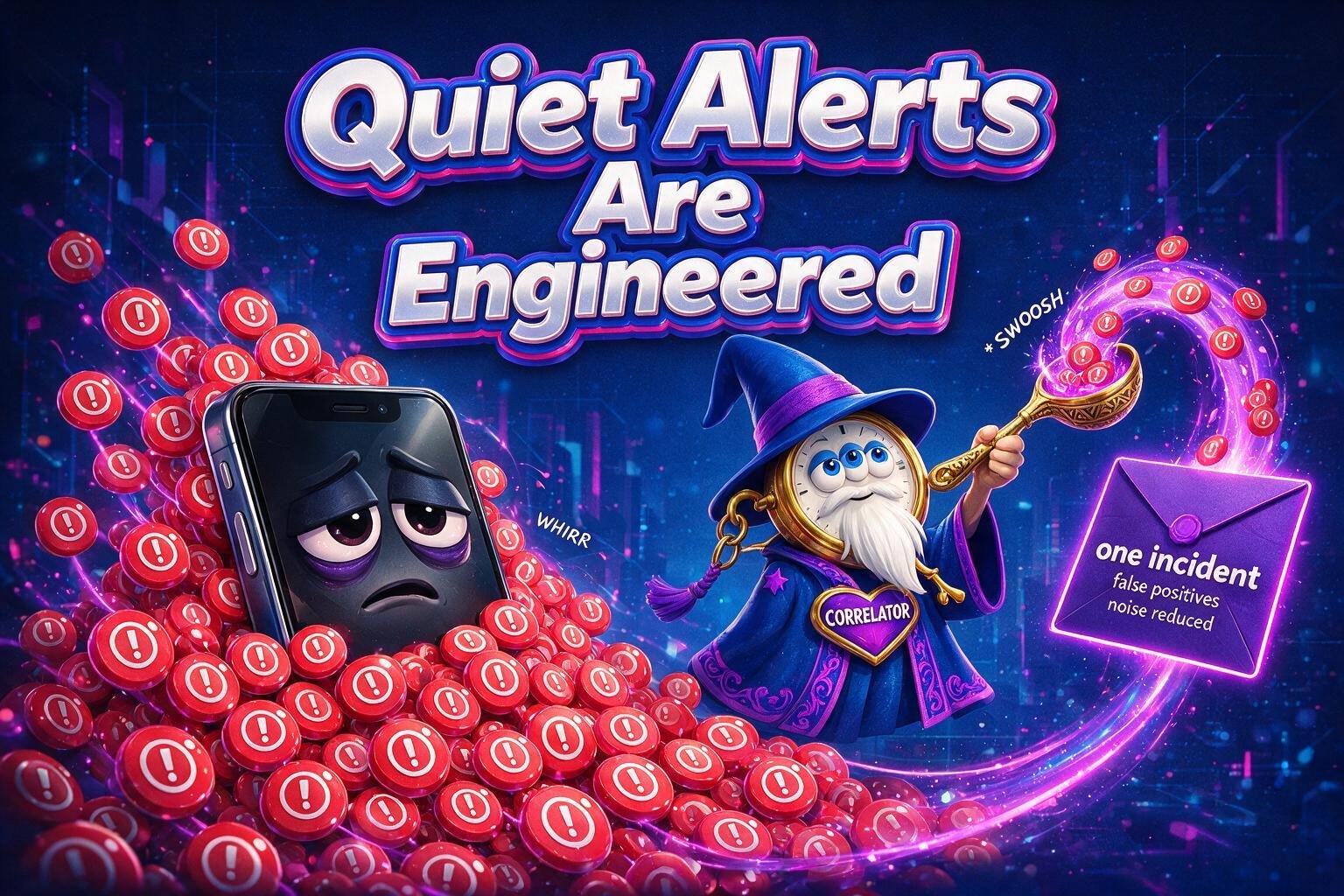
One device went offline and the system told me hundreds of times.
The first message might have been useful. The next several confirmed persistence. After that, the alerting system was no longer describing an incident. It was creating one.
This is how notification stacks fail: every producer believes its event deserves direct access to a human. The camera emails. The cloud pushes. The automation sends a second push. A monitoring job creates a task. Another agent posts a completion notice about the task that summarized the notifications.
The system becomes extremely observable and completely unreadable.
Events are not incidents
A device can emit dozens of events during one outage:
offline
still offline
retry failed
still offline
cloud disconnected
local monitor missed ping
still offline
online
A human needs two messages: one incident and one recovery.
The missing component is correlation. Group events by source, site, device, and failure type. Require persistence before escalation. Suppress unchanged repeats. Promote only when severity increases. Close the incident after a meaningful recovery window.
That logic is not cosmetic filtering. It is the alert product.
Severity is a delivery decision
Every alert needs a lane.
- Page now: immediate danger, active compromise, total outage, or lost protection.
- Needs action: important but not seconds-sensitive; send once and wait.
- Digest: routine warnings, brief flaps, completed background work.
- Log only: searchable evidence that should not interrupt anyone.
If every source chooses “page now,” the actual emergency competes with maintenance noise and status chatter.
Critical paging should remain deterministic. An AI can group, summarize, and rank lower-severity material, but smoke, panic, or hard protection loss should not depend on a model deciding whether the prose sounds urgent.
Recovery deserves one message
Bad alerting systems are obsessed with failure and vague about recovery.
They send twenty warnings, then either send twenty more “online” messages or quietly stop. A useful incident has a lifecycle:
suspected -> confirmed -> acknowledged -> recovering -> resolved
The recovery message should say what recovered, how long it was affected, and whether any residual check remains. That is closure, not celebration.
Silence has to be proven safe
Quieting a system can hide problems if the suppression rules are sloppy. A paused parent monitor may silence all its children. A failed notification route can look identical to a quiet day. A digest job can die and leave no evidence.
So the alert system itself needs tests:
- inject a synthetic event into each severity lane;
- prove the intended destination receives it;
- prove duplicate events collapse;
- prove escalation occurs when state worsens;
- prove one recovery arrives;
- prove suppressed events remain searchable;
- prove the broker reports its own failure through an independent path.
Quiet is valuable only when it comes from correlation, not disconnection.
The best alert stack is not the loudest guardian. It is the one that earns the right to interrupt you.