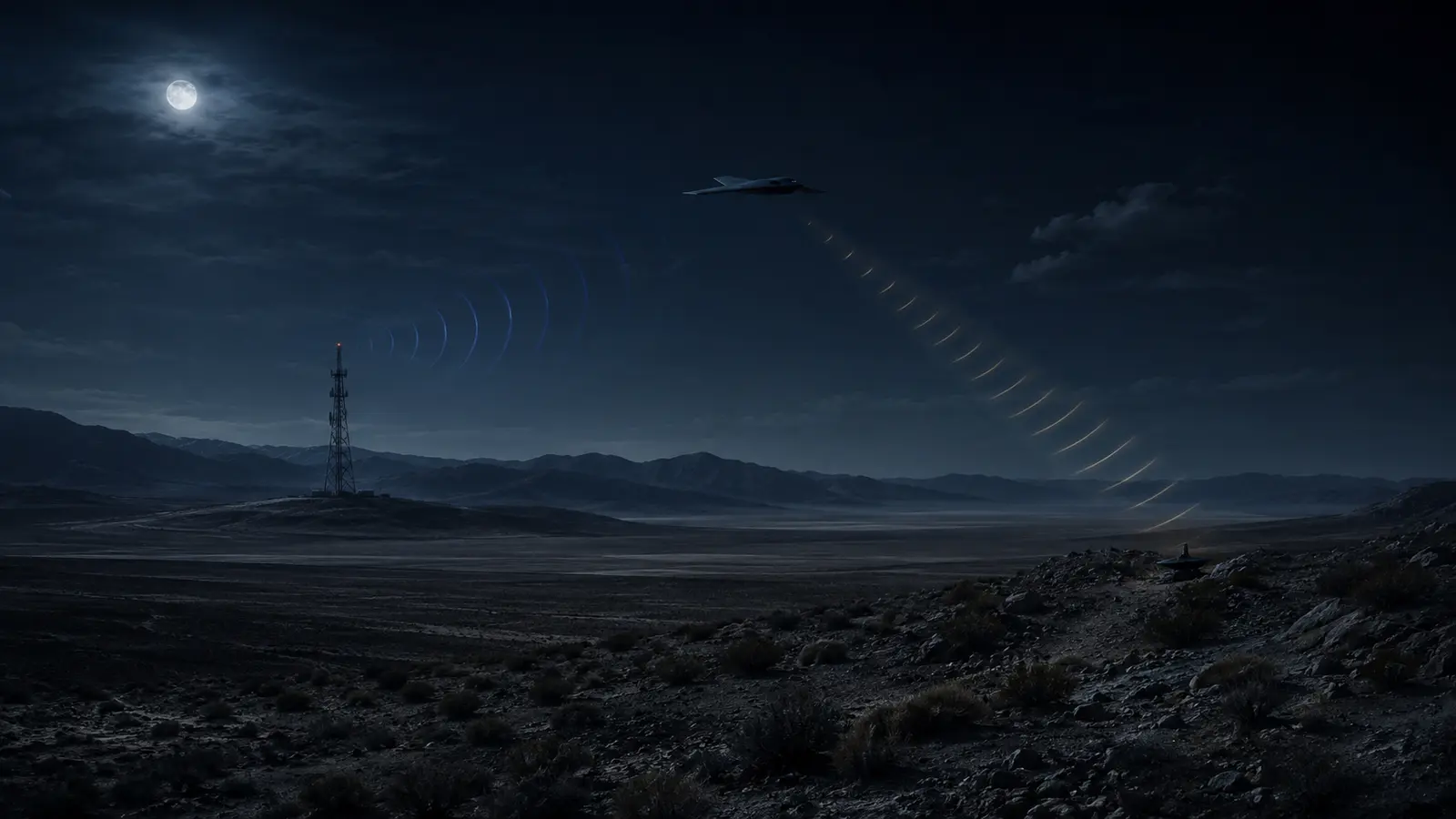
Two unexplained FM stations broadcast synthetic music from inside America's most secretive flight-test ranges. The strongest public explanation is stranger than pirate radio: the music may exist so aircraft can reflect it.

Wideband FM audio from the Tonopah Test Range emitter complex.
Wideband FM associated with a tower inside the Groom Lake perimeter.
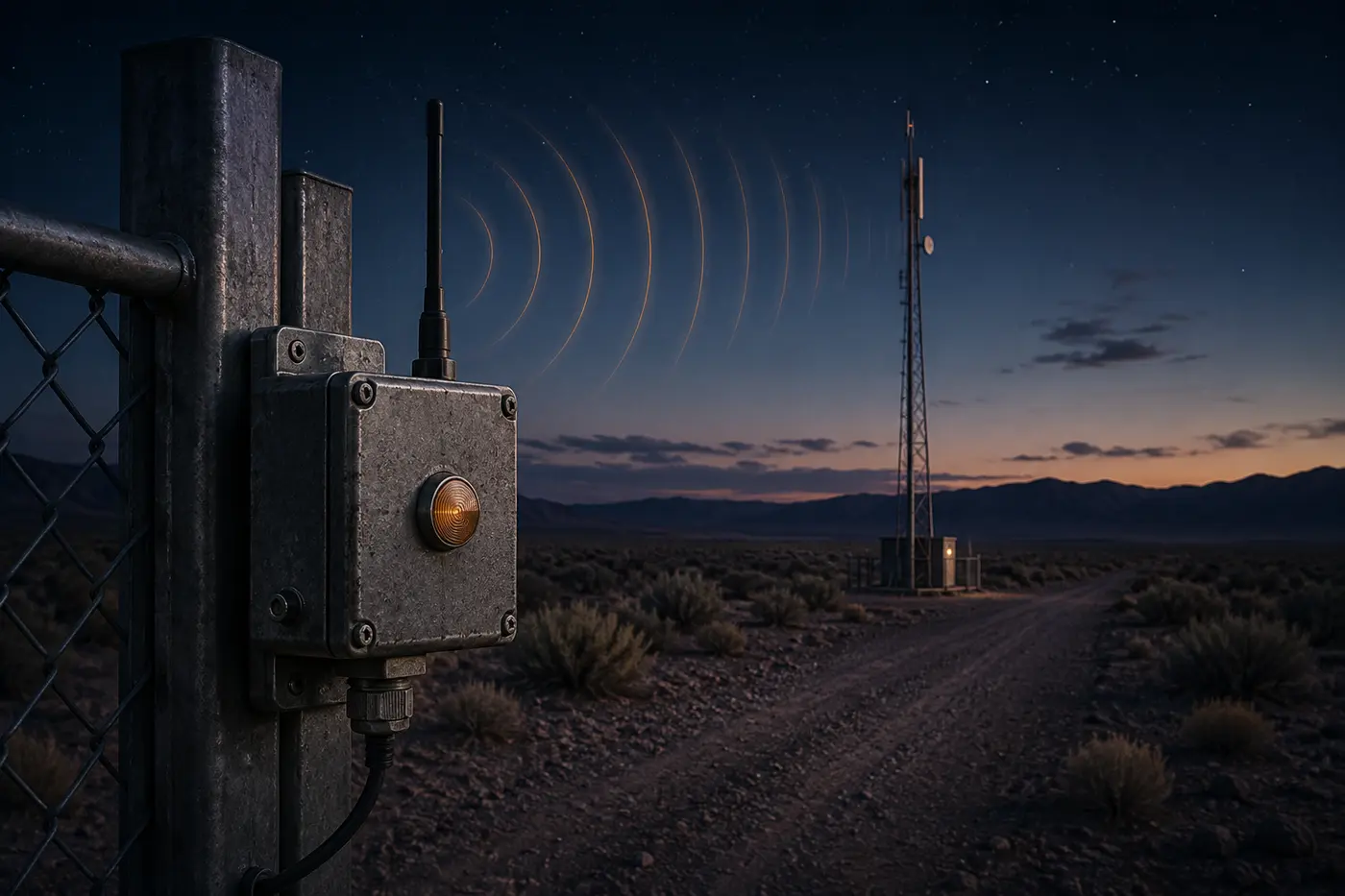
A short UHF alert from a motion detector—not an FM radar illuminator.
The short version
There are two different technical stories hiding inside the scanner observations:
- Ordinary wireless perimeter sensors can notice a person or vehicle and transmit a brief alert.
- High-mounted transmitters deeper inside the Nevada ranges broadcast actual wideband FM audio where there is essentially no civilian audience.
The gate system watches people. The FM system appears more likely to support aircraft, radar, calibration, or electronic-warfare testing. Calling both “passive sensors” is technically defensible and practically confusing as hell.
Verified: the received signals, frequencies, visible towers, schedules, public equipment identification, and correlated flight activity. Reasoned inference: passive-radar or countermeasure testing. Unknown: the classified purpose of “PLUTO,” and whether it listens, jams, calibrates, or does something else.
What was actually found
99.1 MHz — “Radio S4”
The signal is reported near EC-West/Site 4 at the Tonopah Test Range, around 37.735467, −116.497500. Public field observations describe synthetic or AI-generated music and a schedule often resembling a workweek: active from Monday morning into Friday afternoon.
Open the reported 99.1 MHz location in Google Maps
99.9 MHz — “Radio Backgate”
A roughly 100-foot tower was documented in September 2024 about 0.4 miles inside the Area 51 back-gate perimeter, around 37.590850, −115.904933. Unlike an ordinary entertainment station, the transmitter has reportedly appeared chiefly during range missions.
Open the reported 99.9 MHz location in Google Maps
433.920 MHz — the gate sensor
Dreamland Resort’s frequency database identifies a Dakota Alert WMT-3000 wireless PIR transmitter at the back gate. A PIR element is passive because it receives changing infrared energy rather than illuminating the scene. The complete device is not radio-silent: after detecting movement, it actively transmits a short alert.
That is mundane commercial hardware doing a useful security job. It is not evidence that the gate itself is secretly running passive radar.
Radar without a radar transmitter
Conventional radar transmits its own pulse and listens for the echo. Passive coherent location borrows an existing transmitter—FM radio, digital television, cellular infrastructure, or another suitable emitter.
One receiving channel records a clean copy of the original broadcast. Another listens toward the surveillance volume for extremely faint, delayed, Doppler-shifted copies reflected by aircraft. Signal processing compares them across many possible delays and frequency shifts.
The receiver can remain electromagnetically quiet. That makes it hard to locate with a radar-warning receiver or target with an anti-radiation weapon.
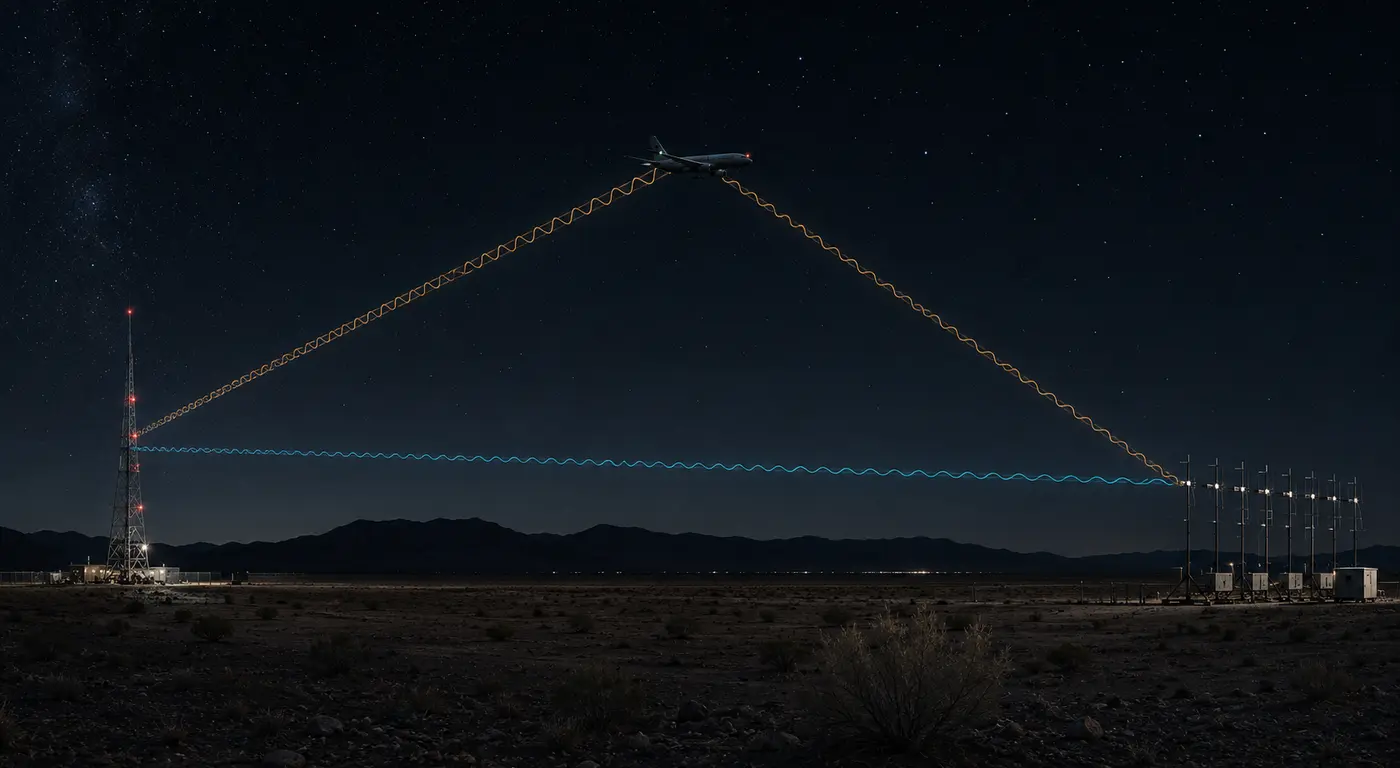
Record a clean copy of the FM waveform.
Remove the enormous transmitter and stationary clutter.
Search delays and Doppler shifts for matching copies.
Combine measurements into candidate tracks.
Bright correlation peaks at a particular delay and Doppler shift become candidate detections.
Bistatic range is an ellipse, not a circle
With transmitter and receiver in different places, one delay measurement constrains the target to an ellipse whose foci are the transmitter and receiver. Additional receiver sites, illuminators, bearings, or time history narrow the possible position.
The stealth problem
Low observable does not mean absent. Stealth shaping and materials reduce signatures against selected frequencies, aspects, and sensor geometries. FM passive radar adds long wavelengths and separated transmitter/receiver geometry, which can create detection opportunities that a conventional radar does not have.
That does not mean “FM radio defeats stealth.” Detection is not identification, precision tracking, or a weapon-quality solution. VHF-scale wavelengths usually bring coarse range resolution, heavy clutter, ambiguous geometry, dependence on outside transmitters, and ugly processing problems.
The aircraft tries to redirect energy away from the colocated transmitter and receiver.
A separated receiver may occupy one of those “elsewhere” directions.
Why the Nevada interpretation is compelling
No public document says, “this tower exists to test passive radar.” The public case is circumstantial. It is still compelling because several independent observations point in the same direction.
An F-117/F-16D mission includes on/off and “max range” calls.
99.9 MHz appears near the Area 51 back gate.
SABRE 41 flies while the FM transmitter is active.
99.1 and 99.9 remain part of public field observations.
Helicopters SUPER 61 and 66 fly a daytime mission from Tonopah; observers suggest a passive-radar test.
SABRE 41 and PLUTO
On October 9, 2024, a Beechcraft shuttle operating as SABRE 41 flew from Tonopah during a mission controlled by RAMROD. Monitors heard references to an onboard system called PLUTO. The 99.9 MHz transmitter was reportedly active during that window.
An earlier F-117/F-16D mission included instructions to turn “Music” and “X-Ray” on and off and select “max range.” Those could be arbitrary test labels. “Music” becomes more interesting when an unexplained music transmitter appears beside the range.
Correlation is evidence—not confirmation. Anyone naming the exact classified system from those recordings alone is bluffing.
September 2026: SUPER 61, SUPER 66, Sonic and Gabby
On September 23, 2026, Dreamland Resort recorded about three and a half hours of mission radio, from 1:20 to 4:54 p.m. local time, in the airspace between Tonopah and Area 51. The players, as Dreamland’s Joerg Arnu logged them:
- RAMROD, the mission controller, same as the PLUTO flight.
- SABRE 07, the Area 51 shuttle N662BA, flying from Tonopah in a support role.
- SUPER 61 and SUPER 66, helicopters, “possibly CH-47 Chinook,” also from Tonopah. They were the mission aircraft.
- Sonic, listed as “radar emitter(?)”.
- Gabby, listed as “passive radar detector(?)”.
Arnu says he had been hearing the SUPER callsigns for about two weeks and had never heard them in the NTTR before. He streamed part of the mission live on September 24 and another SUPER 61/66 mission on September 25. His description of that one calls it “likely related to passive radar system research.”
Keep the question marks where he put them. The passive-radar reading started as a suggestion, and Arnu passed it along as one. It does fit the shape of the problem: a separate emitter and a quiet receiver is how bistatic radar works, as covered above. Slow helicopters also make sensible targets if the goal is to see what an FM-style passive system can track low and slow. None of that is confirmation. Nothing public ties Sonic or Gabby to the 99.1 or 99.9 transmitters, and the evidence ladder below stays where it was.
A NATO educational example describes an aircraft tracked over the North Sea using one FM broadcast.
HENSOLDT says Twinvis can process up to sixteen FM illuminators simultaneously.
Twinvis publishes a horizontal-accuracy figure for 90 percent of tracks.
Why synthetic music?
FM radar performance depends partly on modulation bandwidth and ambiguity behavior. Silence approaches a featureless carrier; complex audio keeps the channel busy and gives a correlator richer structure.
A known synthetic program can also be repeated while aircraft, geometry, receiver settings, or countermeasure modes change. In the remote Nevada desert, a range-controlled illuminator avoids dependence on commercial stations that may be weak, badly located, or operationally unpredictable.
AI-generated music may also be a cheap licensing solution. We cannot prove it was selected for radar properties.
A repeatable source for measuring a passive receiver.
A known FM waveform for evaluating airborne electronic attack.
A timing and geometry reference for another sensor network.
Range entertainment is possible, but fits mission-only timing poorly.
What else lives out there
The theory fits the test-range ecosystem:
- Foreign threat radars: Soviet and Warsaw Pact systems reproduce realistic emitter environments for aircraft and countermeasure testing.
- Legacy stealth: Retired F-117 Nighthawks still support test work from Tonopah as instrumented aircraft and targets.
- EC-West and Site 4: Emitter sites can replicate hostile environments and measure airborne systems.
- Telemetry and scoring: Optical trackers, radar, telemetry, instrumentation, and fiber provide ground truth for experiments.
If the range is evaluating a jammer, the tower could emulate the hostile illuminator while an aircraft carries the countermeasure. If it is evaluating a passive receiver, the same tower supplies controlled illumination. The visible infrastructure supports both hypotheses.
Update — September 2026
Nothing about the two music transmitters has hardened since this post went up. They are still the same two signals, still tied to missions, still explained best by passive-radar or jamming tests, and still unconfirmed by anyone official. What changed is the map around them.
- The closest public viewpoint closed. On March 25, 2026, the Bureau of Land Management closed about 22,987 acres around Badger Mountain, which includes the long-famous Tikaboo Peak viewpoint, to all public entry for at least a year. The order cites public safety and conflicts among land users. It does not mention Area 51, and watcher sites arguing that security was the real reason are guessing. Full file: The 2026 Tikaboo closure.
- The road sensors are still there. Dreamland Resort’s long-running sensor page said in April 2025 that the buried road sensors documented since 2003 were still in use with no obvious changes. That is a different equipment lineage from the gate motion sensor covered above, and nothing here says where any of them are.
- A new microwave tower went up. Satellite imagery logged by Dreamland shows a new tower built between late August 2024 and April 2025 near the base’s newer data center. It is a relay story, not a music story.
- The hobby world caught up. A March 2025 radio forum thread spread both signals to a wider audience, with the usual guesses about jamming and hidden data. Good evidence that anyone can still hear them. No evidence of purpose.
This post is now the first entry in a larger project: Area 51: The Public Record, which covers the declassified U-2 history, the land withdrawals, the Janet flights, and the rest of the paper trail.
Sources and confidence
This is a public-source field investigation, not a classified briefing. The strongest evidence covers things that can be photographed, received, timed, or read in technical documentation. The exact Nevada mission remains unknown.
- Uncanny Expeditions — Tonopah and Area 52 field expeditions
- Dreamland Resort — Area 51 back-gate radar and FM observations
- Dreamland Resort — NTTR and Area 51 scanner-frequency database
- Dreamland Resort — recorded mission notes and callsigns
- NATO STO — passive bistatic radar and waveform diversity
- HENSOLDT — Twinvis passive-radar specifications
- Journal of Radars — jamming methods against passive radar
- Dakota Alert — 3000-series wireless sensor documentation
- Temporary closure notification, Badger Mountain area (March 25, 2026) — Bureau of Land Management
- Area 51 news timeline — Dreamland Resort
- Area 51 road sensors — Dreamland Resort
- 2 FM stations broadcasting within Area 51 — RadioDiscussions forum
- Secret Mission in the NTTR airspace north of Area 51 featuring SABRE 07, SUPER 61 and 66 (recorded September 23, 2026) — Dreamland Resort
- Live audio from a mission in the NTTR: SABRE 07 and SUPER 61 & 66 (September 24, 2026) — Dreamland Resort
- SUPER 61 and 66 at it again: live radio traffic of the mission in the NTTR (September 25, 2026) — Dreamland Resort
Published August 29, 2026. Updated September 26, 2026. Frequencies and field observations are public. The classified purpose of the Nevada systems is not.