By Justin Fahmie · September 2026

Interpretation of the remembered object at Grandma Ann’s; the exact artwork, furnishings, and scene remain unknown.
I can’t give you the manufacturer. That would make this much easier.
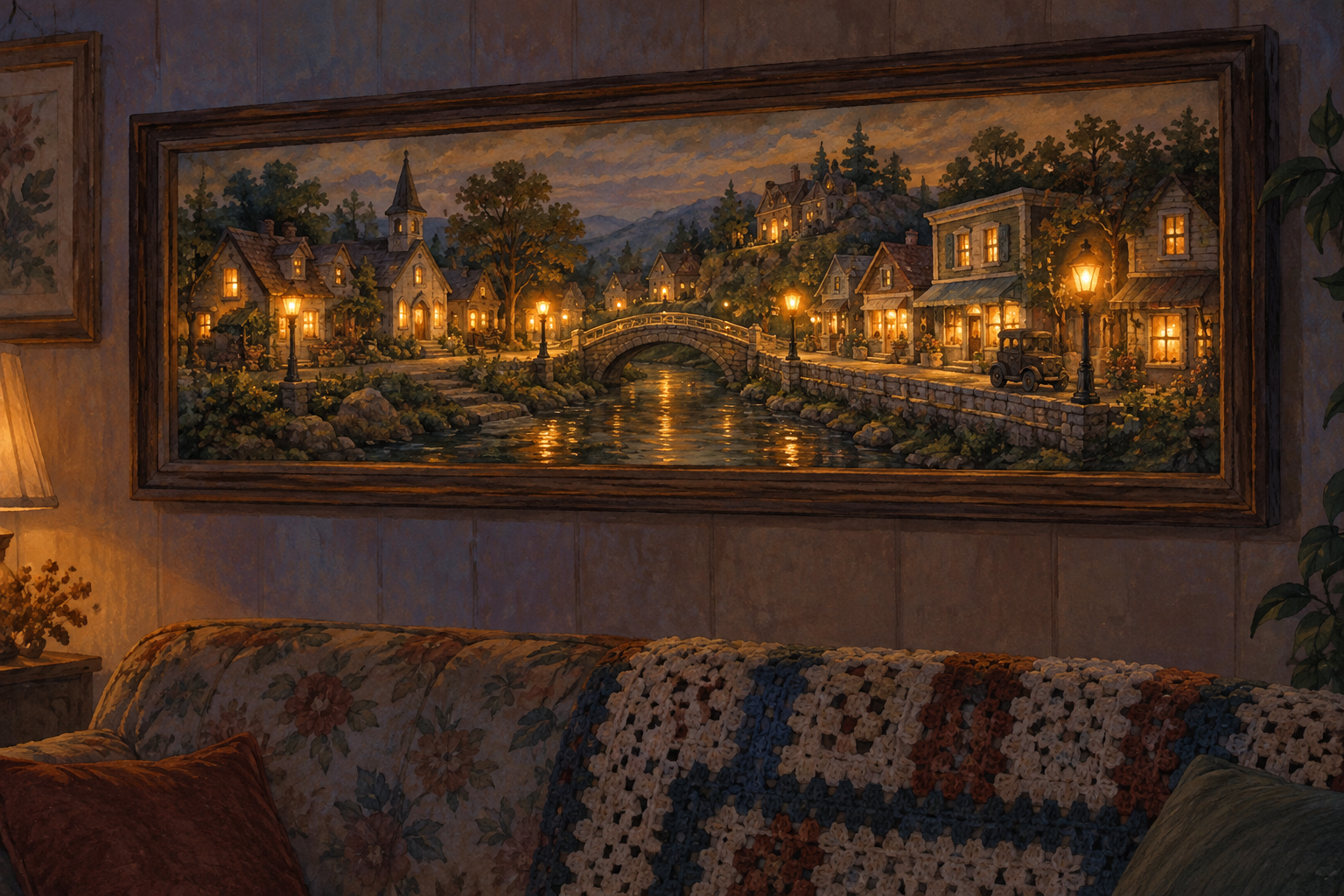
I can tell you it was above the couch at Grandma Ann’s house. She lived in a trailer in Iowa. The picture was huge, at least in the way I remember it. About as long as the couch. An old-fashioned street scene, buildings, a bridge, and little lights.
The little lights actually worked.
That’s the part I keep coming back to when I try to explain it. The windows weren’t only painted to look warm. The streetlamps weren’t just dots of yellow. There was light in the thing. Dim, warm light inside a little world somebody had made and hung on the wall.
I loved it.
It’s a funny thing to carry for years: a fairly strong attachment to an object you can’t reliably name. Memory has kept the features it cared about and discarded the information a search engine would find helpful. Somewhere there may have been a label with a model number. My brain decided we could manage without it.
Excellent archival practice, young Justin.
When I started looking for something like it again, I ran into the difference between recognizing the category and recognizing the thing. An example could have illuminated windows and an old street and still feel wrong. Another could be close enough to bring back some of the feeling while clearly being a different scene.
The search became partly about the picture and partly about figuring out which details had survived. How much was the object? How much was the size it seemed to have when I was a kid? How much was the way the light felt in that particular room?
I don’t have an exact inventory of what was painted in it. I have the couch underneath, the street scene above, and that wonderful fact that somebody had made the lamps light up.
That fact remains enough to interest me.
I’ve spent a lot of my life enjoying things that do something. A radio brings a distant voice into a room. A little arrangement of components changes what becomes possible. A page somebody built connects a person to information they didn’t have. I like seeing the relationship between the pieces and the effect.
The picture had an effect I could understand without taking it apart. A window with light behind it feels different from a window drawn on a surface. It invites you to pay attention. The scene has one small extra layer of reality, even though you know perfectly well it’s a picture.
I don’t need to make myself a childhood engineering prodigy to explain why I liked it. I was looking at a cool thing at my grandma’s house. Plenty of people would have liked it. My particular contribution was apparently to remember it long enough to give myself a research project decades later.
There’s affection in that project that no product match can entirely resolve. If I found the exact model, I would have the model. I wouldn’t have recovered the room, the time, or being the kid who saw it there. A purchase can put an object on a wall. Memory brings the rest on its own terms.
Still, I understand wanting something close.
You can miss the small ordinary things that made a place itself. The things nobody would have thought to document because they were simply there. A couch. A picture. Little lamps that worked. They don’t have to be rare or expensive to take up a permanent bit of space in your history.
I have worked with a lot of screens since then. Brighter ones, sharper ones, things capable of displaying almost anything. That doesn’t make the dim little lights less interesting to me. Their limits were part of what they were. One scene, one effect, enough to hold a kid’s attention.
The exact picture is still uncertain. The attachment isn’t.
If I find something close, I’ll know what I’m looking for before I know what to call it.
The streetlamps will actually light up.
Source and edition note
Based on Still Building, chapter 2. Preserves the Iowa trailer, couch, old street scene, bridge, warm lights, and later search. Size is explicitly remembered rather than measured. No product identification or childhood dialogue has been supplied.
Written with AI assistance in Justin’s requested voice from his shared history and the original Still Building memoir. Reflective prose is a reconstruction, not a verbatim interview. The illustration is an artistic interpretation; people, objects, rooms, and settings are not exact documentary depictions.