By Justin Fahmie · September 2026

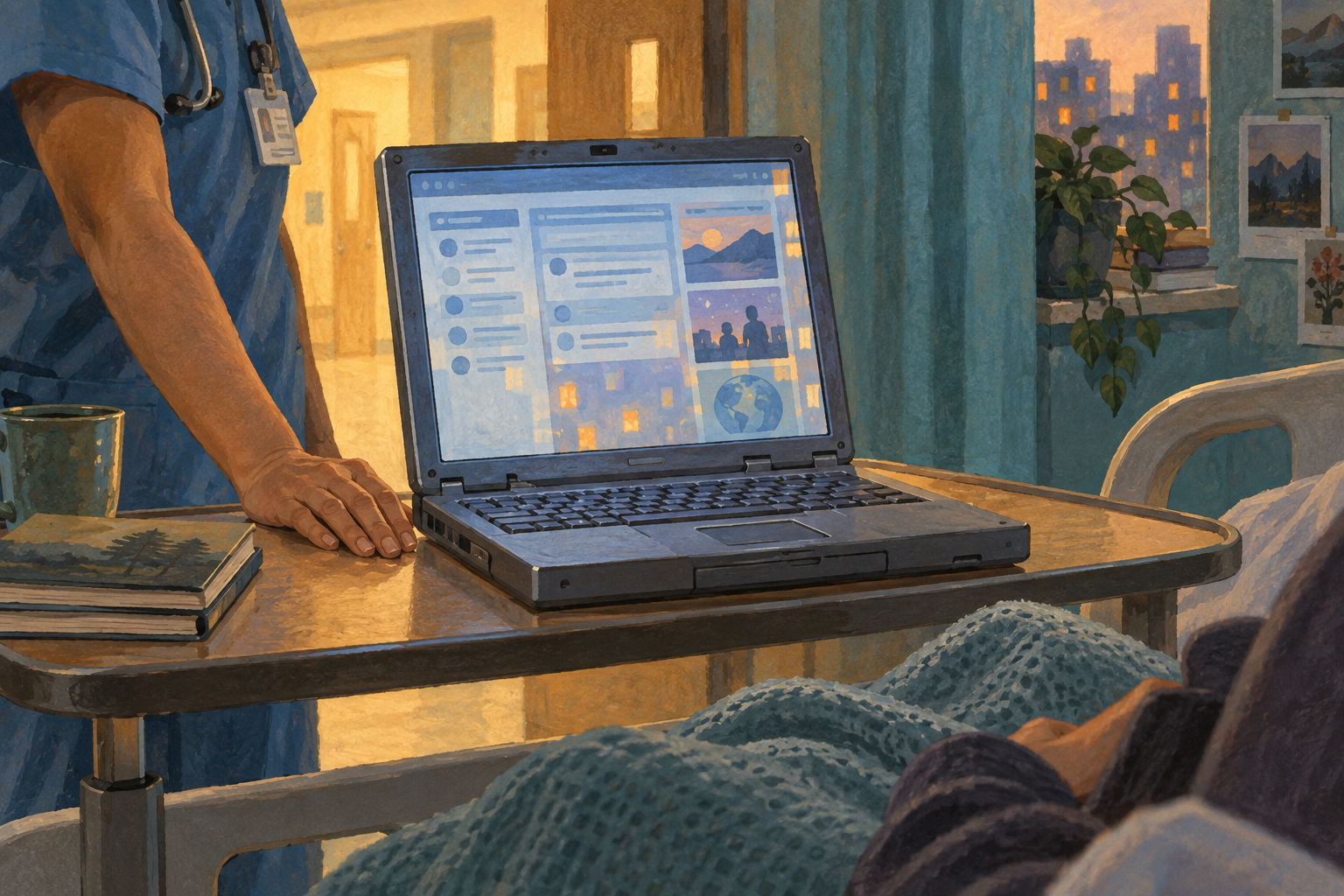
An imagined act of practical care; the nurse, laptop, and room are not exact reconstructions.
There is a laptop in the story of how I found out I had Crohn’s disease.
If you know me, that probably sounds inevitable. Of course the computer guy managed to get a computer into the hospital story. But the computer guy was a sick teenager first. Somebody had to bring him the laptop.
A nurse did.
I wrote about it in April 2006, when the experience was much closer than it is now. The account describes getting sick during high school, losing weight, trying to get through school with bathrooms that offered very little privacy, and going through appointments without a useful explanation. Eventually, at Children’s Hospital in Denver, the thing happening to me got a name.
Crohn’s.
A name is useful. It also comes with a whole new category of questions. You have an answer to what is wrong, and suddenly you need answers about how to live with it. You’re still the same kid. You still have the same body. Now there’s a word connecting it to a future you hadn’t planned for.
The laptop gave me somewhere to take those questions.
I could get online. I could learn about the disease. I could find people who were living with it. That last part matters as much as the information. There is a difference between reading that a condition exists and discovering actual people on the other side of the description. People with lives that continued after the diagnosis. People for whom the unfamiliar thing had become something they could talk about.
I don’t remember a specification sheet. I’m not going to improve the memory by inventing the brand, the screen size, or a speech the nurse delivered while setting it down. The detail that survived was the useful one: she got me access.
When you’re a teenager, growing up is already a fairly large assignment. Adding a chronic illness doesn’t cancel the original assignment. You still have to become a person while learning a lot of things you would have preferred never to need.
Having something I could investigate mattered. I couldn’t troubleshoot my way out of being sick. I could follow a question far enough to understand a little more than I had before. I could come back with another question. I could do something besides sit inside the uncertainty.
That’s the part of technology I keep coming back to, even after years of making a living with it. A tool becomes interesting when it gives somebody a useful next move. The next move might be fixing a network. It might be understanding a form. It might be finding another person who knows what the hell you’re talking about.
The nurse didn’t need to solve my whole life for that to count.
I think practical kindness gets underestimated because it doesn’t always announce itself. Sometimes it looks like noticing what a person could use and putting it within reach. There’s no requirement that the object be impressive. It has to help the person in front of you.
Years later, I’m still sick. I’ve built a business and a family life while dealing with that. There wasn’t a moment when the laptop opened and the difficult part ended. I wouldn’t want to tell that version, even if it made a cleaner article.
What happened was smaller, and it has lasted longer than a neat ending would.
Somebody brought a sick kid a way to ask questions, find people, and feel a little less cut off from the world. I became a person who cares a great deal about useful tools and the difference they can make in an ordinary day.
I can’t draw a straight line from one act to an entire life. I can recognize the act when I look back.
Before there were all the networks, projects, and equipment, there was a nurse who brought me a laptop.
I still think about that.
Source and edition note
Based on Still Building, chapter 4, and its account of Justin’s April 2006 post. The original post could not be independently retrieved in this pass (403). No exact onset age, diagnostic interval, nurse identity, or dialogue has been added.
Written with AI assistance in Justin’s requested voice from his shared history and the original Still Building memoir. Reflective prose is a reconstruction, not a verbatim interview. The illustration is an artistic interpretation; people, objects, rooms, and settings are not exact documentary depictions.