At first, the number felt impressive.
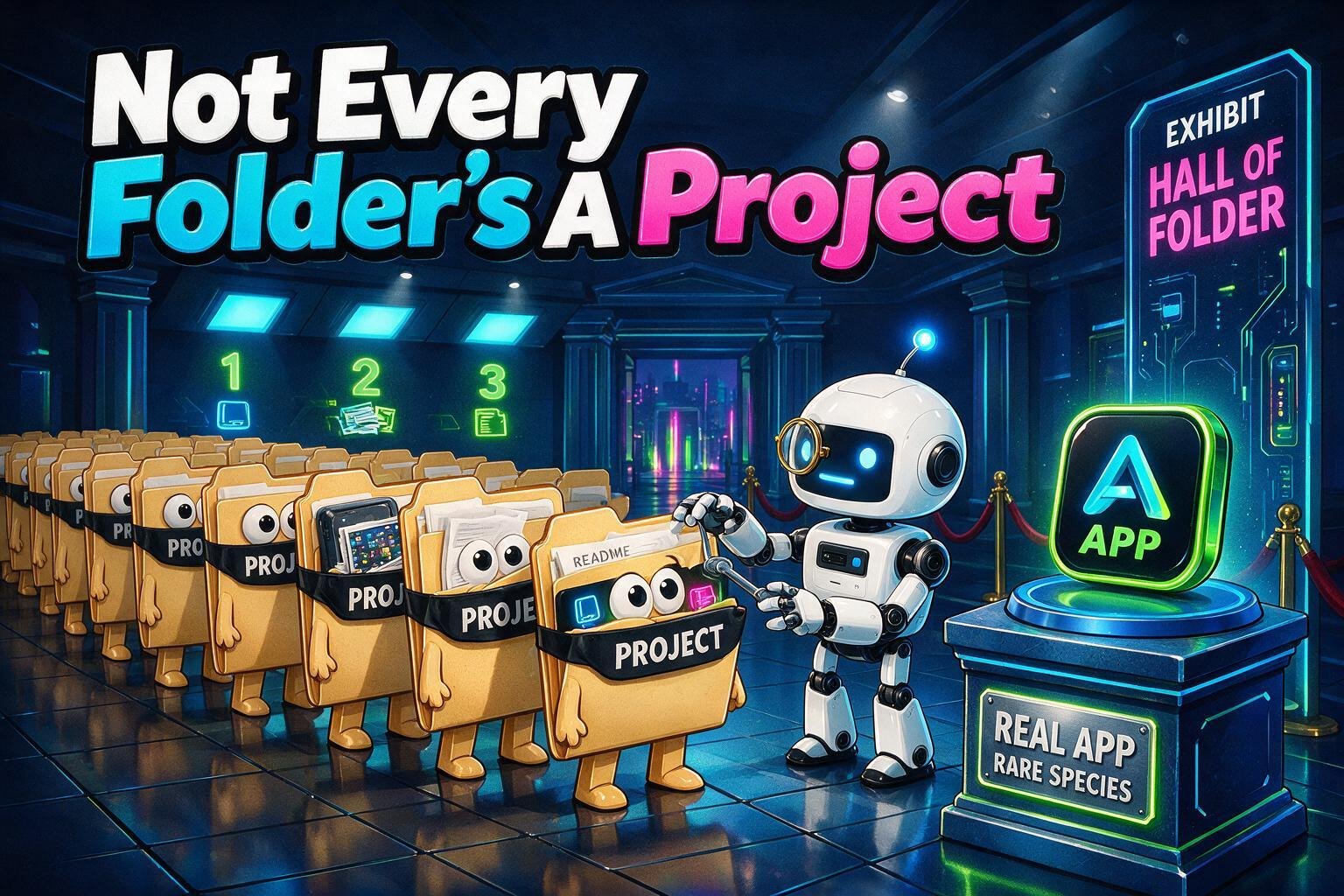
Hundreds of project-looking records appeared in a machine-wide inventory. There were apps, dashboards, scripts, experiments, backups, copies, screenshots, exports, abandoned prototypes, and directories that contained one README describing something that had never existed.
The raw count made it look as if I had built a small software empire.
The second pass revealed the truth: the filesystem does not know what a project is.
Directories are terrible status reports
A folder can mean almost anything:
- the authoritative source of a working application;
- a generated build output;
- a copy made before a risky change;
- a failed prototype;
- a downloaded dependency;
- a report about a project;
- a collection of screenshots;
- an idea with no code;
- an old source tree that production stopped using months ago.
If an inventory treats all of them equally, its precision is fake.
The opposite mistake is also common: looking only for Git repositories. Plenty of real tools began as one useful script, while plenty of repositories contain scaffolds that never became useful.
A project needs evidence
I ended up classifying candidates with separate questions:
Does it have source?
Does it build or run?
Was it ever deployed?
Is it still used?
Is this copy authoritative?
Does it have documentation?
Can a human reach the outcome?
Those answers form a state, not a yes/no label.
idea, prototype, built, deployed, operational, stale, replaced, and archived are different things. A useful catalog preserves those differences instead of squeezing everything into “project.”
Copies need lineage
The most confusing records were not dead experiments. They were successful copies.
A build directory may contain the exact version that shipped. A later working directory may contain newer source that never deployed. A backup may preserve the only known-good artifact. A cloned repository may have a remote but be years behind the live system.
Without lineage, the newest timestamp wins by accident.
A good inventory records:
- canonical source location;
- runtime or public endpoint, if any;
- last verified build and run;
- relationship to copies and archives;
- current owner and intended destination;
- whether the item is safe to delete, merely safe to ignore, or neither.
The museum beat the spreadsheet
The raw inventory became useful only after it turned into a browsable museum.
Screenshots, descriptions, status badges, and direct links made forgotten work visible again. The goal was not to maximize the count. It was to answer ordinary questions: What did I make? What still works? What deserves finishing? What should be archived? Which copy is real?
That is the difference between storage and memory.
The filesystem can tell you where bytes live. A project catalog has to explain what those bytes became.
The project is not the folder. The project is the chain from intent to artifact to a result somebody can still use.