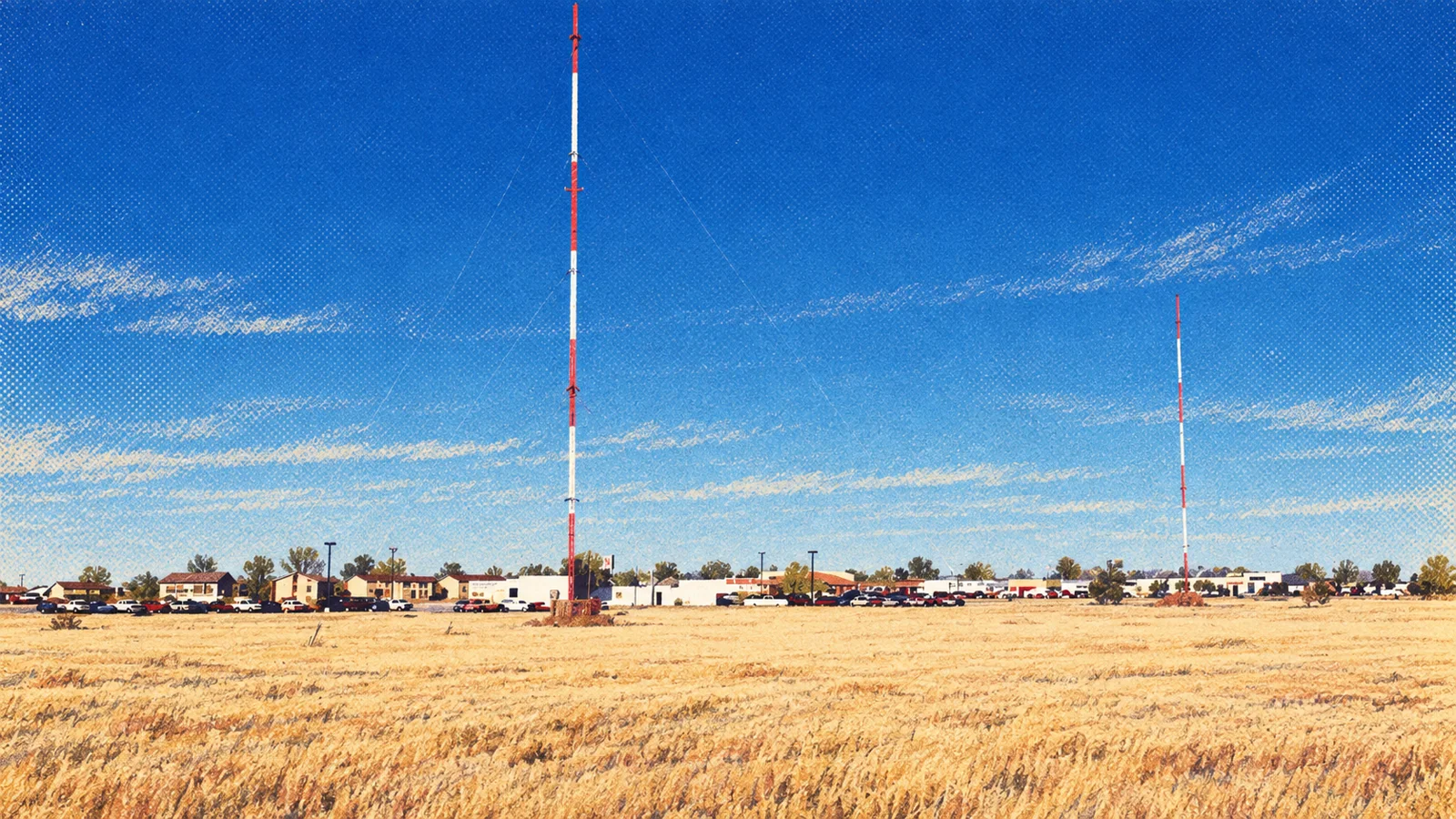
A radio station, a car lot, and a childhood lived between two towers
By Justin · September 2026
For most drivers, they were simply two red-and-white towers rising from the flat ground along Highway 50. For Justin, they were part of home: the vertical frame around his family’s used-car lot, and a humming remnant of Pueblo broadcasting hidden behind office doors.
The address was 2600 W US Highway 50 in Pueblo, Colorado. Before it became Hwy 50 Autoplex, the property was the two-tower directional transmitter site for KGHF 1350 AM. The station rooms did not vanish when the car lot arrived. Some equipment remained alive, warm, and loud—generators, relay racks, a fallout shelter, and a large RCA transmitter whose vacuum tubes glowed through the cabinet.
This is what can be proven, what survives in family memory, and what is still missing.
| Station fact | Detail |
|---|---|
| FCC facility | 53850 |
| Frequency | 1350 kHz |
| Historic power | 5 kW day / 1 kW night |
| Night operation | Two-tower directional array |
| Former site | 2600 W US Highway 50 |
The photograph that fixes the memory to the ground
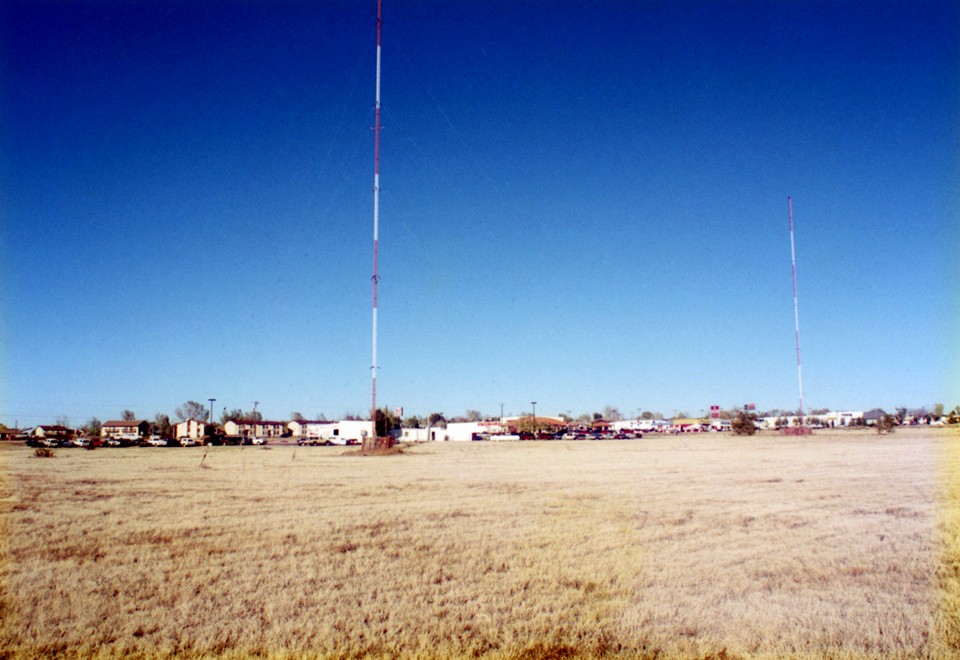
Original family photograph, circa 1990s. The Autoplex buildings sit between the two active towers. The taller western tower dominates the frame; its partner stands to the east.
The transmitter coordinates printed in the 1992 Broadcasting Yearbook—38°18′29″N, 104°38′24″W—land on this same property. A USGS-derived record places the former KGHF-AM tower at 38.3080577, -104.6405303.
One frequency, many names
The license stayed on 1350 AM while its call letters and owners changed around it. The Highway 50 plant spans the middle of that story.
| Call sign | Approximate period | Note |
|---|---|---|
| KGHF | 1928–1964 | Original call; the Highway 50 plant was built during this era |
| KKAM | 1964–1976 | Garvey-era identity |
| KIDN | 1976–1988 | Country-era identity |
| KRYT | 1988–1989 | Brief AM identity |
| KGHF | 1989–2008 | Historic call restored; transmitter site moved in the late 1990s |
| KDZA | 2008–2012 | |
| KCCY | 2012–2018 | |
| KBPL | 2018 | |
| KDZA | 2018–2022 | |
| KUBE | 2022–present | The present license operates from a different site |
KGHF was authorized in 1927 and signed on in January 1928 from the Congress Hotel. It moved from 1430 to 1320 kHz, operated from the Broadway Arcade Building, and used an earlier transmitter location near Lake and Maryland Avenues. The 1941 North American reallocation moved it to 1350 kHz.
In 1947, Colorado Broadcasting applied to raise power to 5 kW day and 1 kW night, install a new transmitter, move the transmitter site, and construct a directional nighttime antenna. ABC listed the project under construction in 1948. Taken together, the evidence places construction of the two-tower Highway 50 plant around 1948–49.
Period directories consistently describe a 5 kW daytime, 1 kW nighttime facility with a directional night pattern. A 1964 directory gives the address simply as “Highway 50, W.” The 1992 yearbook prints the exact coordinates.
An October 1997 filing proposed a new transmitter point roughly three miles north, with 4.7 kW day and 750 watts night. The old towers came down in the late 1990s. The 1350 license survives today as KUBE from a different site.
Why were there two towers?
At night, AM signals travel farther because they can reflect from the ionosphere. Stations sharing a frequency have to protect one another from interference. KGHF’s second tower was not a spare. Together, the two energized towers formed a directional array: their signals combined in some directions and partially canceled in others, shaping where the nighttime signal traveled.
The two towers were therefore one antenna system, engineered around the nighttime assignment on 1350 kHz.
The room that sounded alive
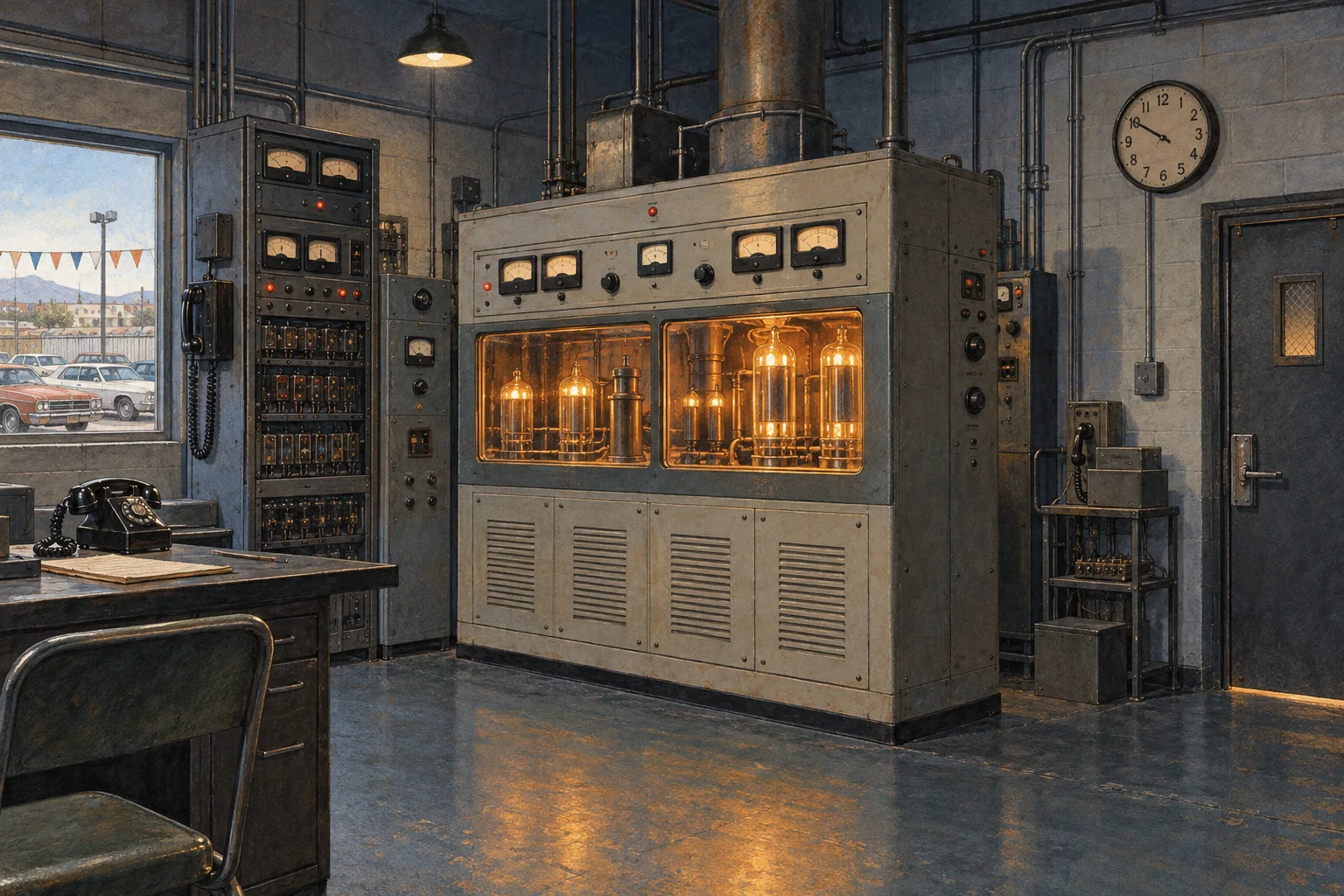
Illustrated reconstruction, not an archival photograph.
“I remember sneaking into the radio-station side, admiring the sounds the broadcast gear made, and the wall of vacuum tubes.”
During the Autoplex years, the front and studio areas had become the business. Behind them, part of the broadcast plant remained restricted and operational. Justin remembers the equipment noise, transmitter heat, generators, tubes, and a fallout shelter. The building was both car lot and machine room—ordinary family life sharing walls with high voltage and a live AM signal.
The station answered the telephone
One surviving memory was unusually precise. Call a telephone number connected to the transmitter site and a computer voice would answer with one word:
ENTER
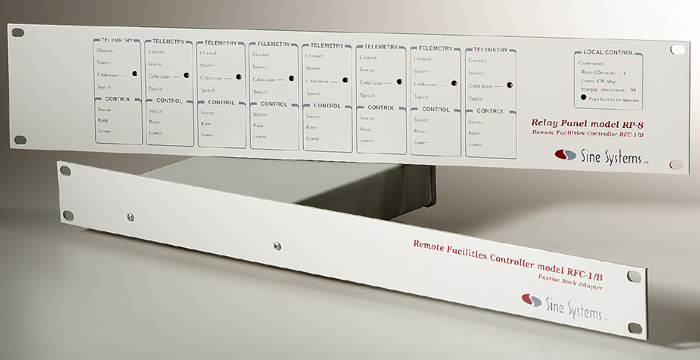
The mystery device is identified with very high confidence as a Sine Systems RFC-1/B Remote Facilities Controller. Sine’s archived firmware manuals say the unit answered the line, spoke “Enter,” accepted an eight-digit DTMF security code, and then read telemetry or operated relays.
It could provide spoken analog readings and on/off status, handle as many as 64 telemetry or control channels, raise or lower transmitter power, switch equipment, report alarms, and place telephone callouts. It even said “Goodbye” before disconnecting.
The remembered password was based on the station frequency. Because the surviving manuals require eight digits, a code such as 13501350 is plausible—but that is only an inference, not a recovered credential.
KKTV is documented. KOAA is still a question.
By the mid-1950s, Colorado Broadcasting—the KGHF licensee—owned half of TV Colorado Inc., licensee of KKTV channel 11. In 1963, KGHF, KKTV, and KFMH(FM) were sold together in an $885,000 package.
That corporate relationship makes television equipment, shared engineering knowledge, or stored material at the KGHF property plausible. It does not prove that KKTV originated programs from Highway 50.
The family was also told that a large rear room had been a television studio, and KOAA-related material was found inside. But KOAA began as KCSJ-TV, whose documented facility was on Big Hill at TV Lane—not at 2600 Highway 50.
The KOAA material may have been stored, salvaged, transferred through engineering relationships, or connected to an undocumented use. For now, saying that “KOAA operated here” goes beyond the evidence.
Hwy 50 Autoplex
The property’s second life was not separate from its first. The car lot occupied the studio spaces while the transmission plant lingered next door.
Justin remembers building Hwy50autoplex.com around 1999 in Dreamweaver after buying the domain through Network Solutions. A 2001 Wayback capture calls it “Hwy 50 Autoplex—Your Friend In the Car Business!” and points into an older Hypermart-hosted site.
His office had a Gateway computer and multiple phone lines. Nearby were his dad’s office, candy and pop machines, customers, mechanics, family friends, and the strange privilege of growing up beneath active radio towers.
Someone documented the inside
In the late 1990s, a group of college students visited the Autoplex for a project. Justin personally led them through the former station rooms while much of the equipment was still intact. They took photographs. Their names, instructor, class, and images are now unknown.
The strongest lead is at CSU Pueblo, then the University of Southern Colorado. Its University Photograph Collection includes an undated “Academics—Field Trip” folder, 1994–2003 slide additions, Mass Communication records, KTSC radio and television records, and a complete run of the USC Today student newspaper. An archives inquiry was sent in September 2026.
The search is for interior photographs, negatives, contact sheets, captions, class projects, and the names of the students or instructor. If you recognize the site or remember the visit, preserve what you have. A handwritten envelope, processing date, or class label may be the key.
Sources and boundaries
- 1964 Radio Annual — Highway 50 address, power, and directional operation.
- 1947 NAB/FCC report — power increase, new transmitter, and directional-site application.
- ABC 1948 annual report — KGHF improvement listed under construction.
- 1956–57 Television Yearbook — the KGHF owner’s 50% interest in the KKTV licensee.
- 1963 Broadcasting report — KGHF, KKTV, and KFMH sale package.
- 1992 Broadcasting Yearbook — former KGHF transmitter coordinates.
- October 1997 M Street Journal — application to relocate the transmitter north.
- Sine RFC-1/B manual — “Enter” prompt, security, telemetry, and control operation.
- CSU Pueblo Archives — university history and record groups.
- University Photograph Collection — field-trip folder and 1994–2003 additions.
- KOAA retrospective — KCSJ-TV at Big Hill.
- Archived Hwy50autoplex.com — surviving 2001 Wayback capture.
Editorial boundary: Family memories are labeled as memories. Generated artwork is labeled as reconstruction or illustration. The television-studio story remains open. The exact FCC completion date for the Highway 50 plant and the college photographs are still outstanding.
Two towers. One frequency. A car lot full of radio history.