By Justin Fahmie · September 2026

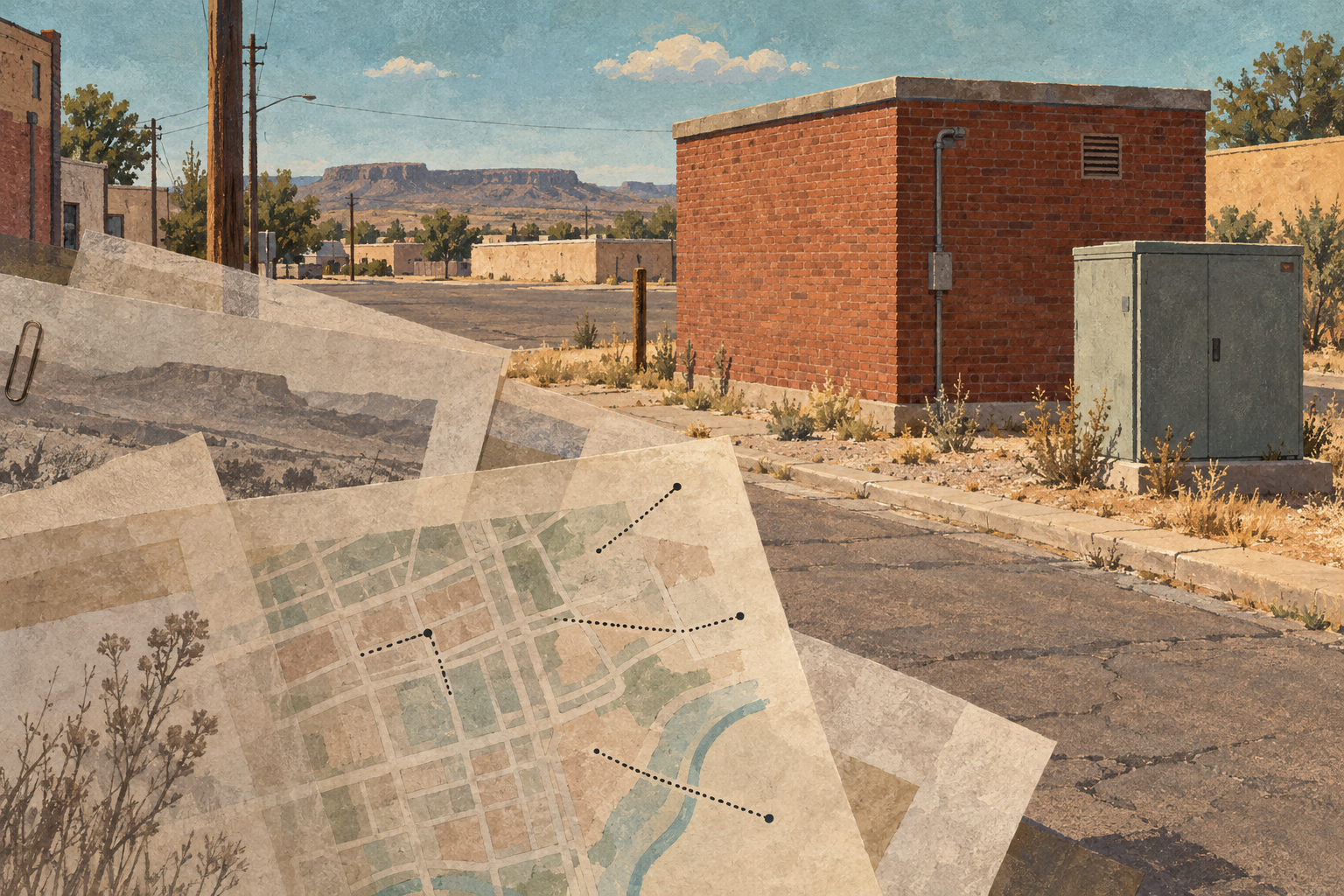
A fictional civic streetscape. The map is conceptual and shows no actual utility route or exact facility.
A perfectly ordinary building can ruin my ability to mind my own business.
It doesn’t need to be especially attractive. Sometimes a lack of windows helps. A cabinet, an unusual bit of equipment, something about the way a site fits into the street. There’s clearly a reason for it to exist, and now I would like to know what that reason is.
Living in Pueblo has supplied plenty of material.
I’m interested in phone systems, fiber, radio, utilities, and the practical machinery that lets a city keep doing ordinary things. Once you start looking at that stuff, the background gets busy. A bridge can carry more than traffic. A plain building can be part of a much larger story. An electrical site can have a history that reaches farther back than the equipment currently standing there.
The difficult part is keeping the interesting possibility separate from the answer.
One of my research threads followed a telecom-looking roadside compound around Medal of Honor Boulevard. That appearance was enough to start asking questions. It was not enough to identify what the place did. The research brought up records for a lift-station project in the corridor, but matching the exact place I was asking about to the documented facility remained unresolved.
That last sentence is less satisfying than a confident identification. It’s also the sentence that keeps the whole investigation honest.
If I let the appearance decide the answer, I can produce a very convincing story about a thing I haven’t actually identified. Put the story on a nice map and it gets even more convincing. The map does not improve the evidence. It mostly improves the font.
Sometimes the records do give you something wonderfully specific.
Pueblo’s Ordinance 10380 documents an exchange involving Intrepid and city-owned conduit across the 8th Street Bridge. The city made conduit space available in exchange for fiber strands for its use. There it is, in the paperwork: an ordinary piece of the city serving a communications purpose you could easily miss while passing over it.
I like that kind of discovery. The interesting thing doesn’t need to be secret. It can be public and sitting inside a document whose title gives most people an immediate desire to do something else.
A council record turns out to explain a small part of how people and equipment connect. It doesn’t reveal the entire network, and I don’t need to pretend it does. One piece becoming understandable is a perfectly good result.
Another thread led to West Station and the city’s Honor Farm history. The city records an electric substation on part of that property since 1951. The utility’s own project material describes plans for later terminal upgrades. The site has a history, proposed changes, and a role in the place around it. What first looks like equipment behind a fence becomes something you can begin to put in time.
That’s the pleasure for me: the moment an object gets some context.
I’m the same person who likes an old repeater page, a phone system, or a computer whose odd behavior suggests there’s something left to figure out. The city is a bigger version of the question. Who needed this? What problem did it solve? What changed around it? What information would let me stop guessing?
There’s usually another question after that. I recognize that this may be a personality issue.
A lot of the work can happen at a desk. That matters when standing and walking are difficult. Documents, maps, historical records, and imagery let me keep investigating even when a long afternoon on my feet isn’t workable. My physical range can change without making the subject less interesting.
And once I’ve spent time making sense of something, I want to preserve the useful part. A readable explanation. A source link. A note about what remains unknown. Something the next interested person can use without beginning the whole search again.
That might be the most consistent thread in my work: I want the thing I wished I’d found at the beginning to exist by the time I’m done.
There are plenty of unanswered questions left in Pueblo. Some will stay unanswered. Some will turn out to be much more ordinary than the first theory. I can live with that.
Ordinary things are doing a remarkable amount of work around us.
I would still like to know what the hell is in that building.
Source and edition note
Based on Still Building, chapter 15, and the September 4, 2026 Pueblo research dossier. The Medal of Honor compound-to-lift-station match remains an unverified lead. The ordinance, Honor Farm page, and West Station project PDF were independently read for this edition. The PDF describes a planned upgrade, not verified completion. No operating topology or equipment identity is inferred.
Written with AI assistance in Justin’s requested voice from his shared history and the original Still Building memoir. Reflective prose is a reconstruction, not a verbatim interview. The illustration is an artistic interpretation; people, objects, rooms, and settings are not exact documentary depictions.