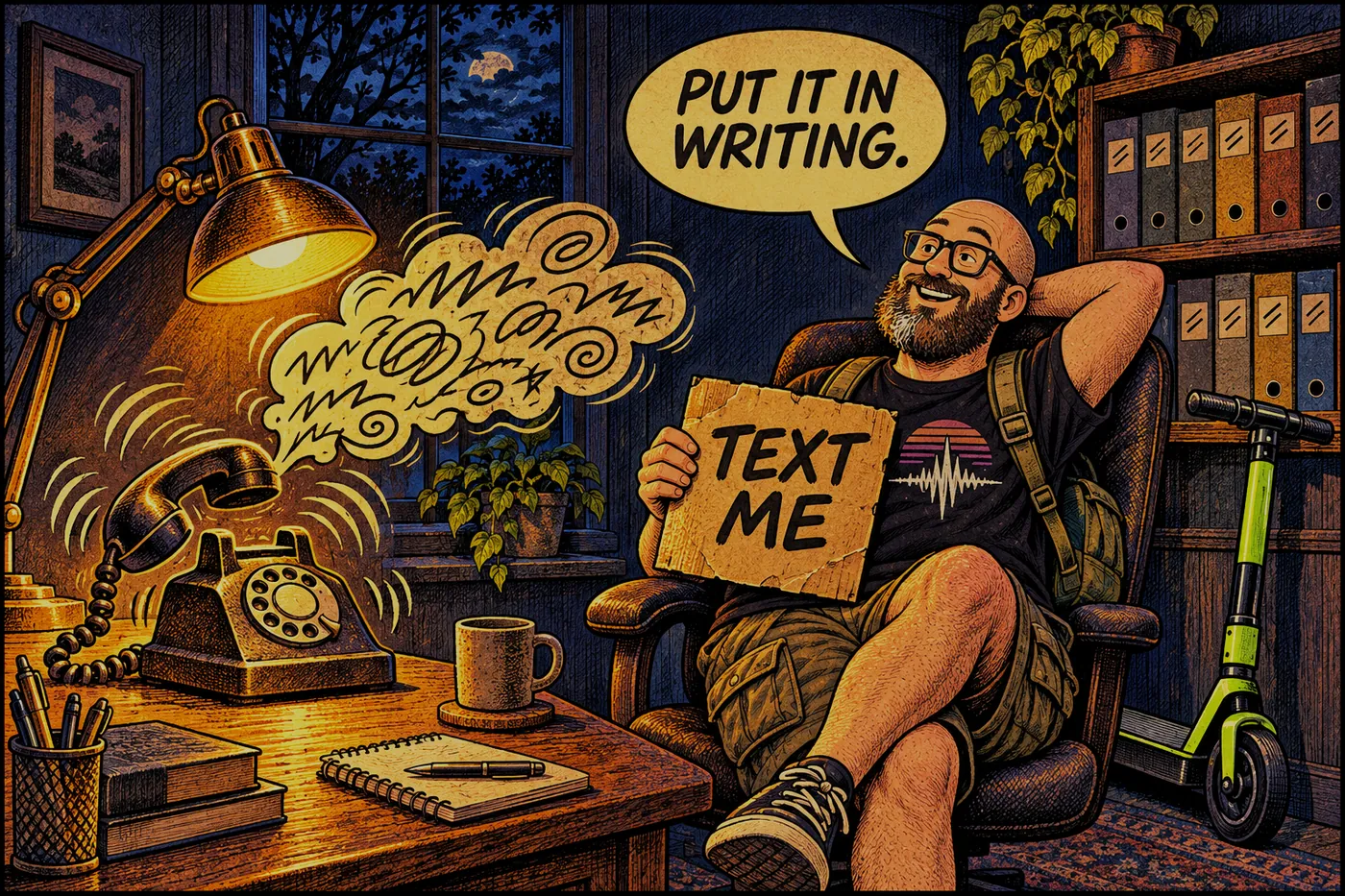
I’m not dodging you. I’m making sure neither of us gets screwed by a conversation nobody can replay.
If you’ve ever called me, you probably got a text back instead. Something like “Hey, can you text me what’s going on?” Some people think that’s rude. Some people think I’m lazy, or antisocial, or just being a pain in the ass.
I get it. On the surface it looks like a guy who won’t pick up the phone.
But there are real reasons. Some are medical, some are about how my brain works, and one of them got proven for me, in writing, by a client this month. So here’s the whole thing, once, with cartoons.
Reason 1: I can’t hear you very well
I have a hard time hearing people. Not “turn it up a little” hard. More like “I caught every third word and I’m guessing at the rest” hard.
Phone audio makes it worse. A classic phone line throws away everything above about 3,400 Hz, and that’s right where a lot of consonants live: the “s,” the “f,” the “th.” Cell calls are often better, until the signal dips and they drop back down to the squeezed version. Then add whatever’s going on at your end: wind, traffic, a TV, a dog, a coworker yelling in the background.
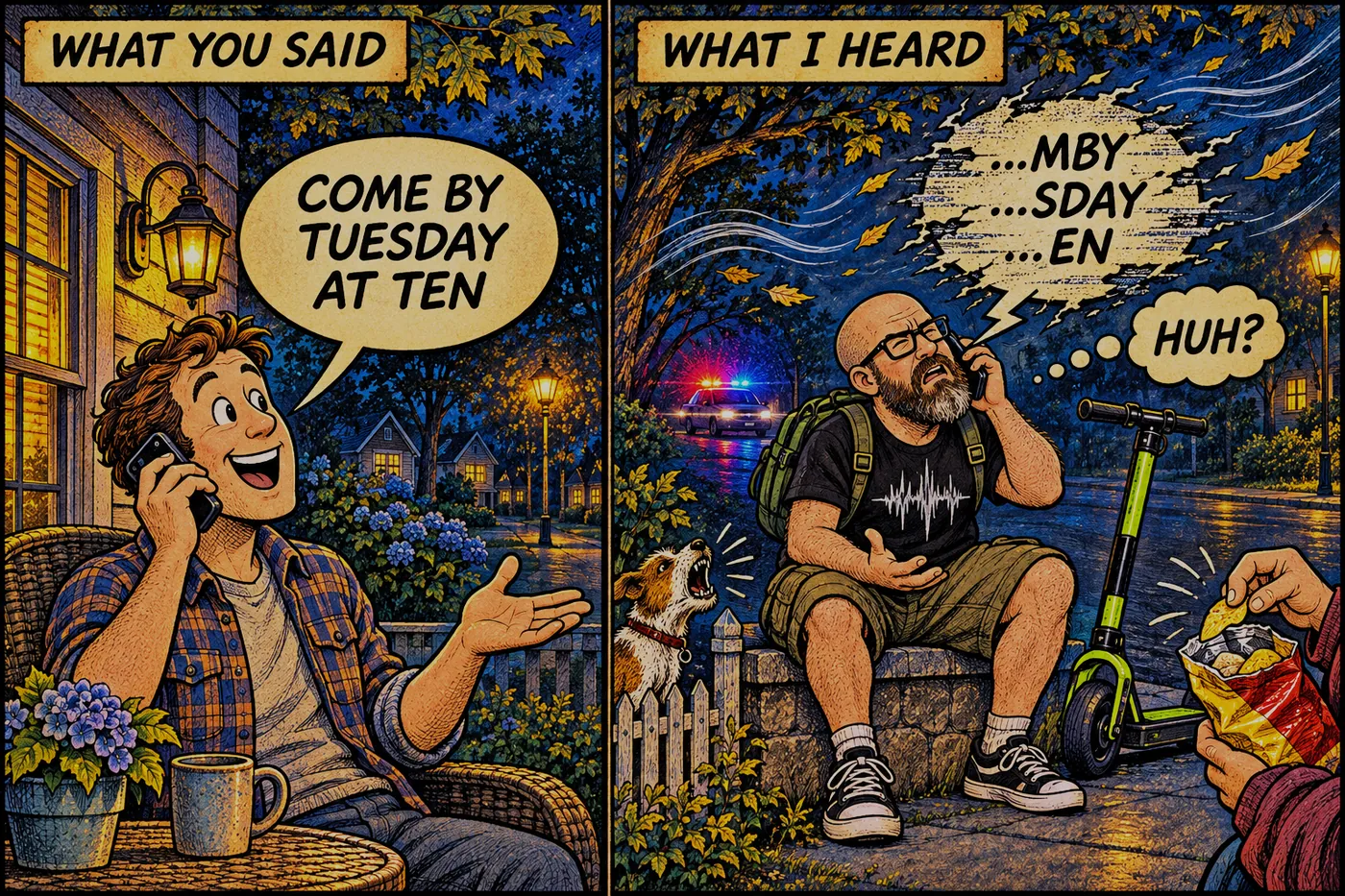
Same sentence. Two very different experiences.
Accents make it harder still. I’m not complaining about anybody’s accent. Everybody has one, including me. But my brain needs a few seconds to tune into a voice it hasn’t heard much, and a phone call doesn’t give me those seconds. Neither does somebody who talks fast.

I can ask you to repeat it once. By the third time, we’re both annoyed.
Reason 2: Misophonia
I have misophonia. If you haven’t heard of it, it means certain sounds hit me like a fire alarm. Chewing. Slurping. Heavy breathing. Mouth noises. Most people tune those out without noticing. I can’t. My body reacts before my brain gets a vote.
A phone call puts those sounds directly in my ear. People eat on the phone. They breathe into the mic. They crunch ice. Once that kicks off, I’m not listening to your words anymore. I’m just trying not to throw the phone across the room.
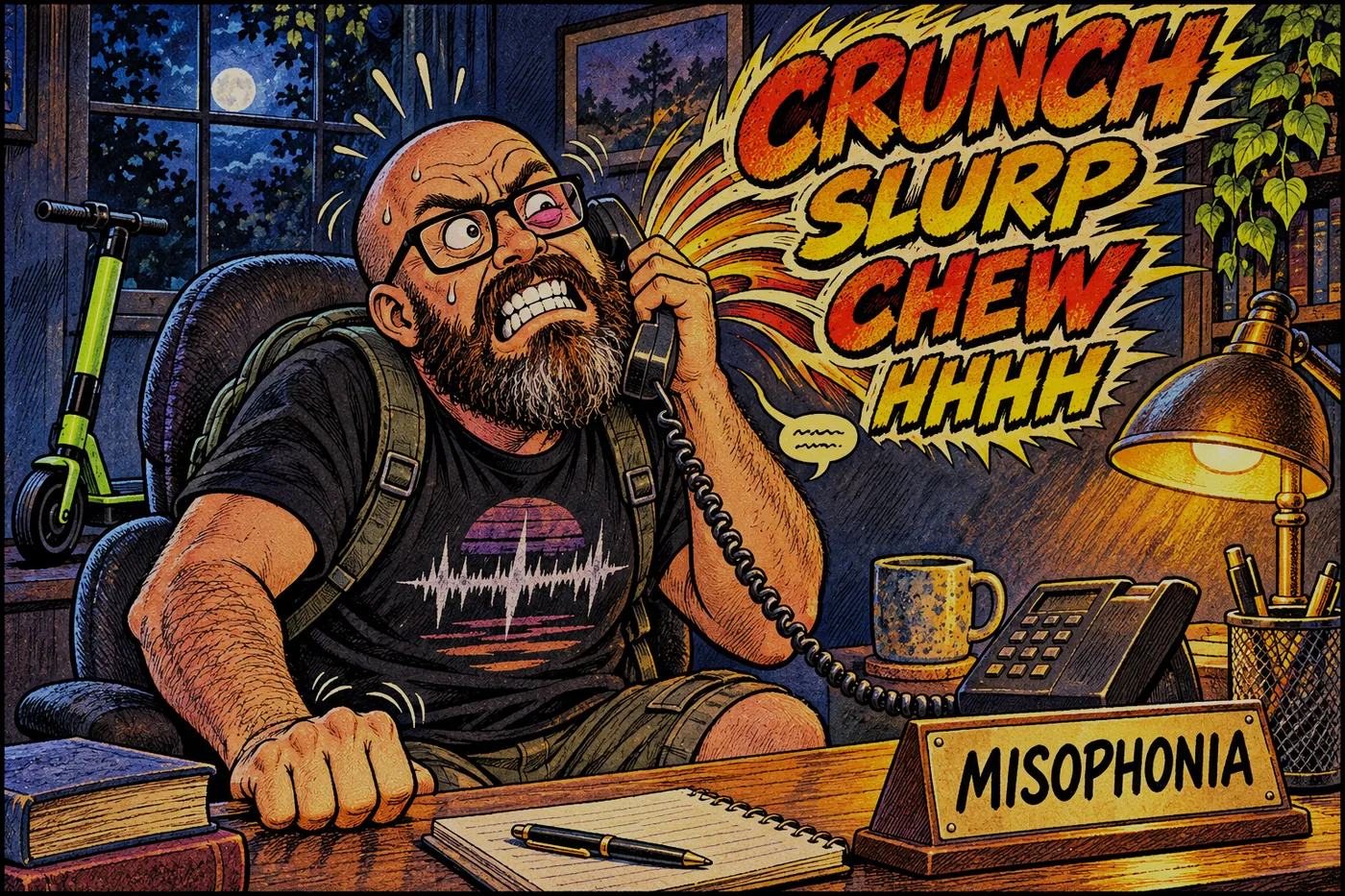
The actual words of this call are somewhere under all that.
Text doesn’t chew.
Reason 3: My memory is a colander
Say you call me with five things. By the time we hang up, I’ve got three of them, maybe. The price you mentioned, the day you wanted, the door that sticks: something falls out every time.
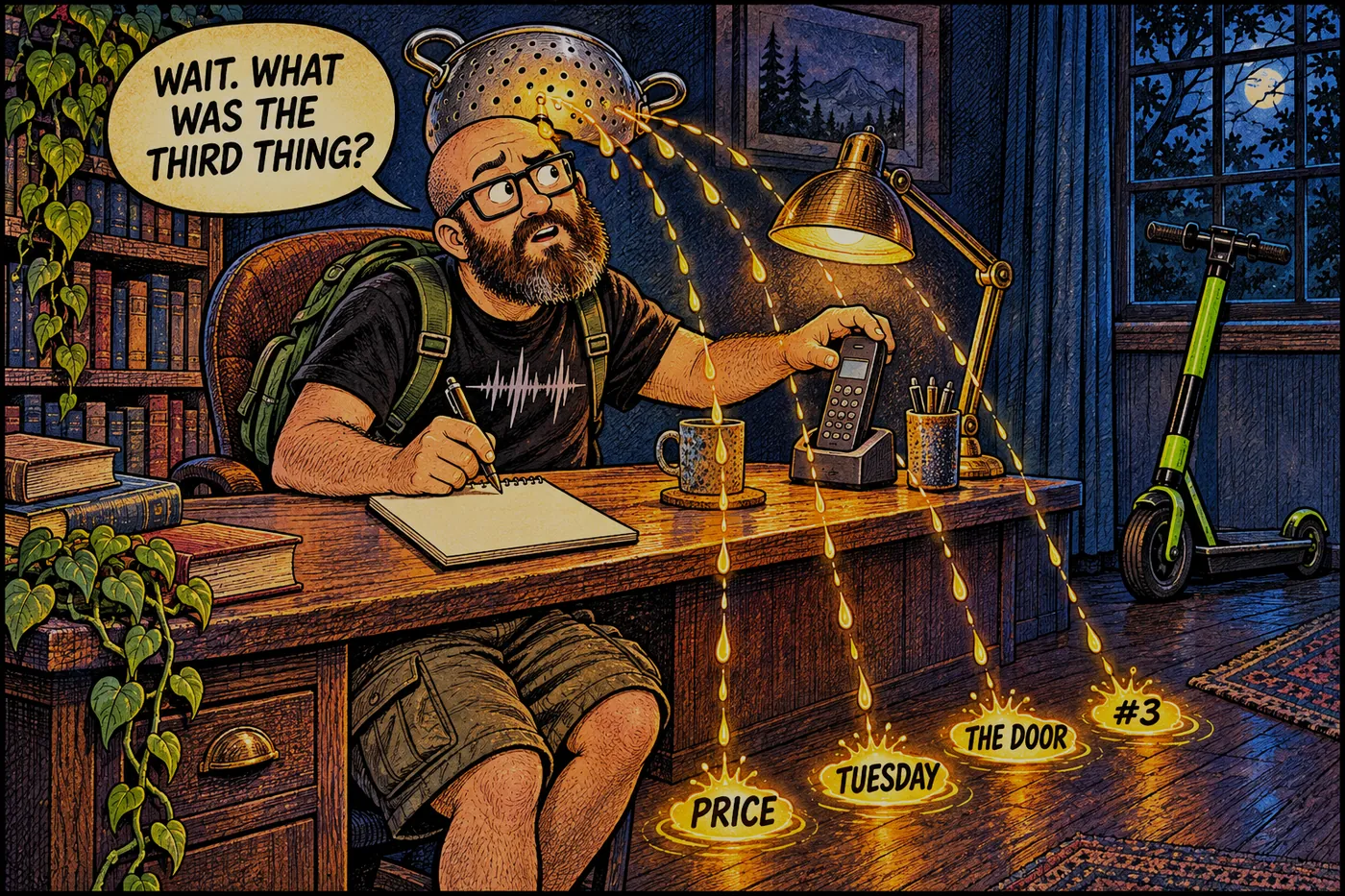
Five things went in. Three came out.
With a text or an email, nothing falls out. I can go back and read exactly what you asked for. So can you.
Reason 4: On-the-spot is my worst spot
Put me on the phone and ask me something unexpected, and my brain turns into a loading wheel. I’ll say “uh, sure” just to keep the call moving. Then three hours later, in the shower, I’ll come up with the right answer, the better question, and the thing I should have warned you about.
I don’t know if that’s autism, ADHD, or what. Probably all of it. The label matters less than the result: live, I’m slow and I miss things. In writing, I can think it through, check what I’m about to say, and give you the right answer the first time.
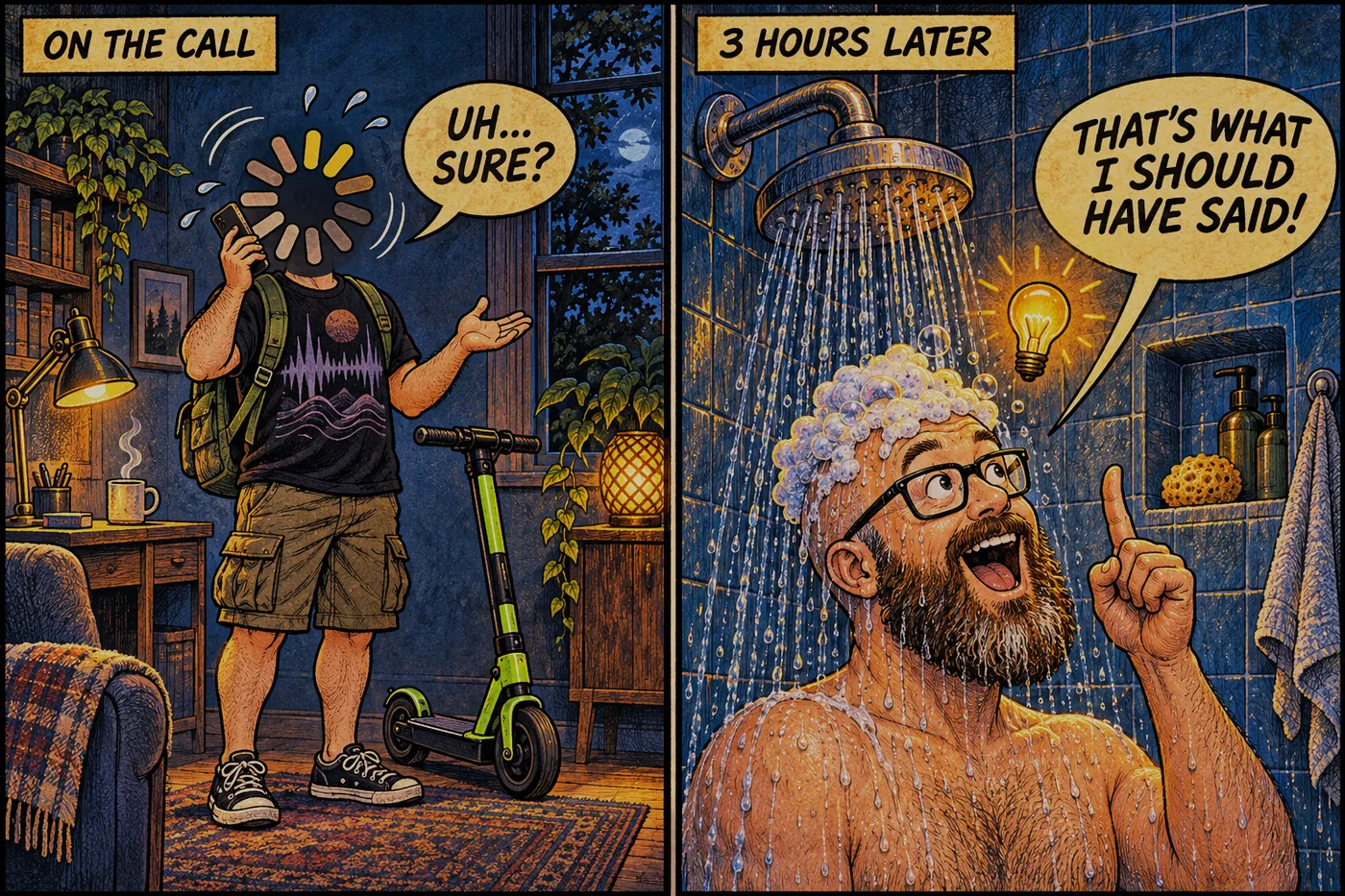
The right answer always shows up. Just not while you’re on the line.
That’s not me being difficult. That’s me making sure you get the version of me that actually knows what he’s doing.
Reason 5: People forget. People remember it differently. And sometimes people just say whatever gets them off the hook.
This is the one that hit home this month.
A recent client wanted security. Cameras, an alarm, the works. So we put it in. Here’s how it went, and every bit of it is in writing with a date on it.
I offered to have it professionally monitored. That means real people watching it around the clock, checking every alert and calling the police. The client wrote back that they’d just monitor it themselves for now. I asked if they wanted it to arm on a schedule or by hand. They wrote back that they’d do it by hand. I also pointed out, in writing, that without monitoring it only works if somebody actually arms it.
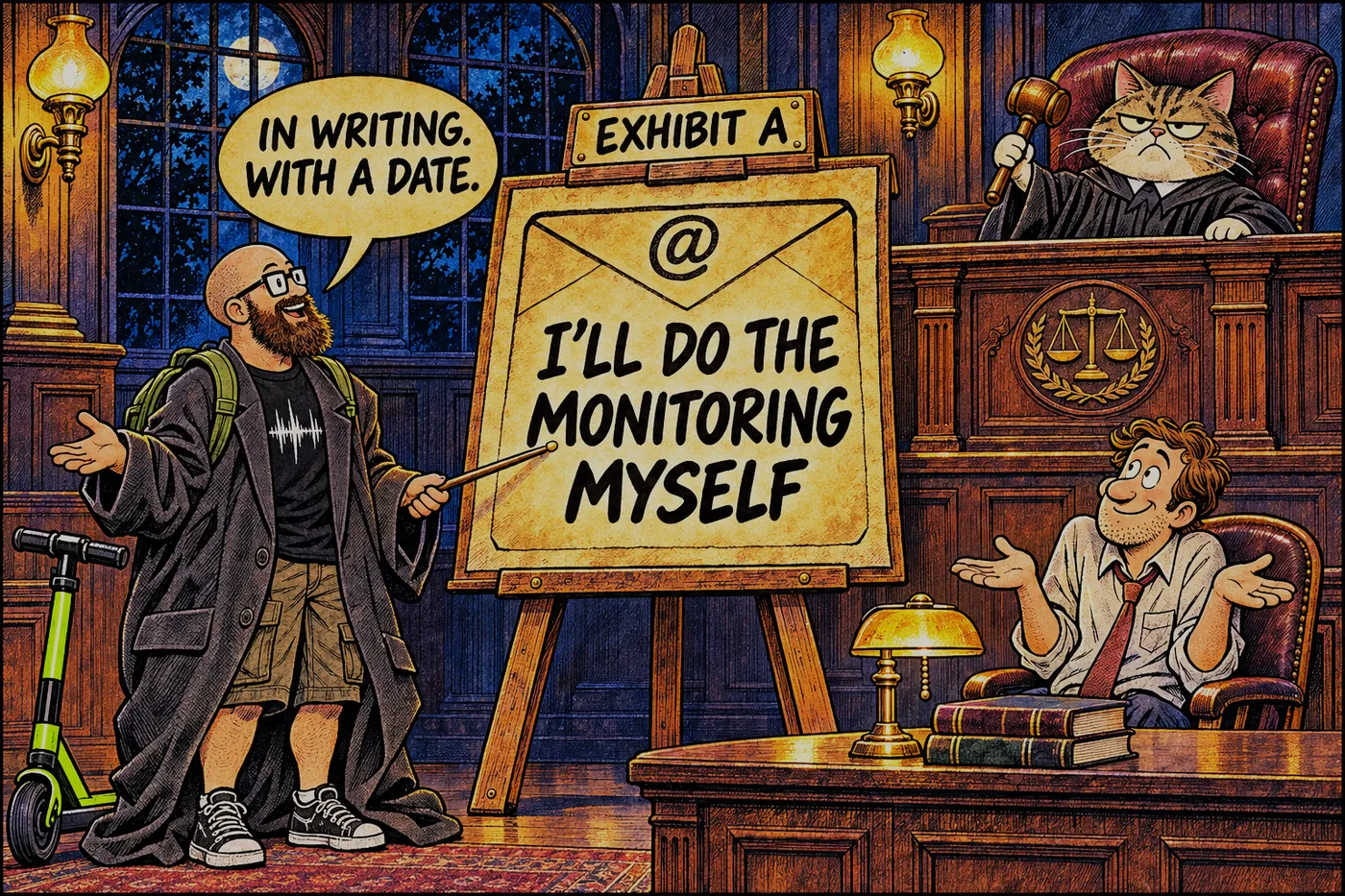
Your honor, I’d like to submit the email.
I wrote them a full user guide. How to arm it, disarm it, watch live, pull up recordings, what every icon means. I sent it. When they said they didn’t know how to set the alarm, I sent it again. A while later, I sent it a third time with extra steps. Along the way I offered, at least four separate times, to come out and walk them through it in person.
At one point they wrote back and asked me not to arm it, because they had people on site.
Here’s my favorite part. That guide lives on a link with a view counter. I checked it again today.
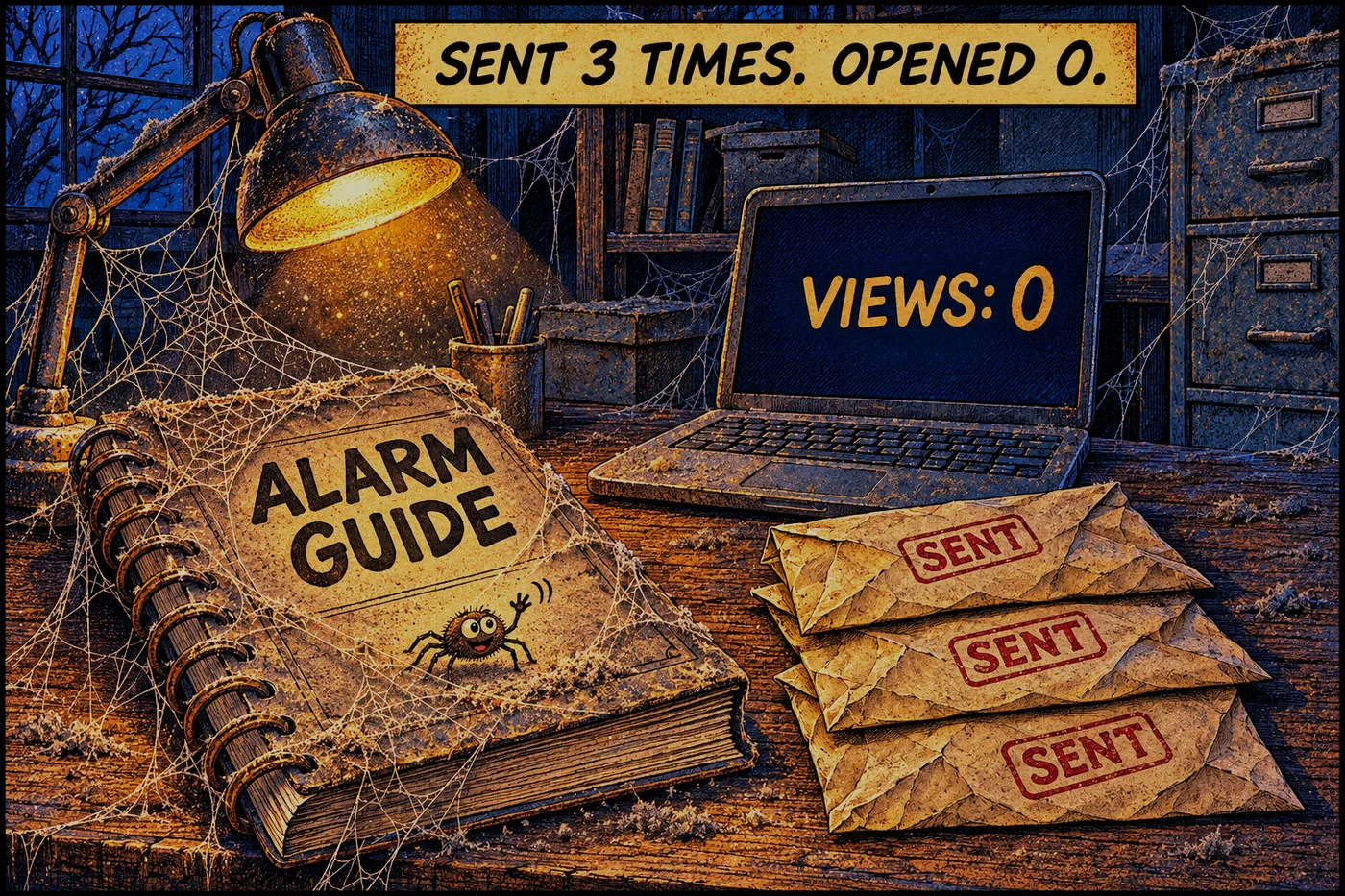
Zero. Not low. Zero. Ever.
Months went by. The cameras did their job. They caught people moving around the property after dark again and again: 261 person detections, in 21 separate incidents, over 11 different nights. Every one of those would have set off the siren and pinged the client’s phone. If the alarm had been armed.
It was never armed. Not once. Meanwhile, the client logged into the camera app 608 times. They were watching the cameras. They just never pressed the button.
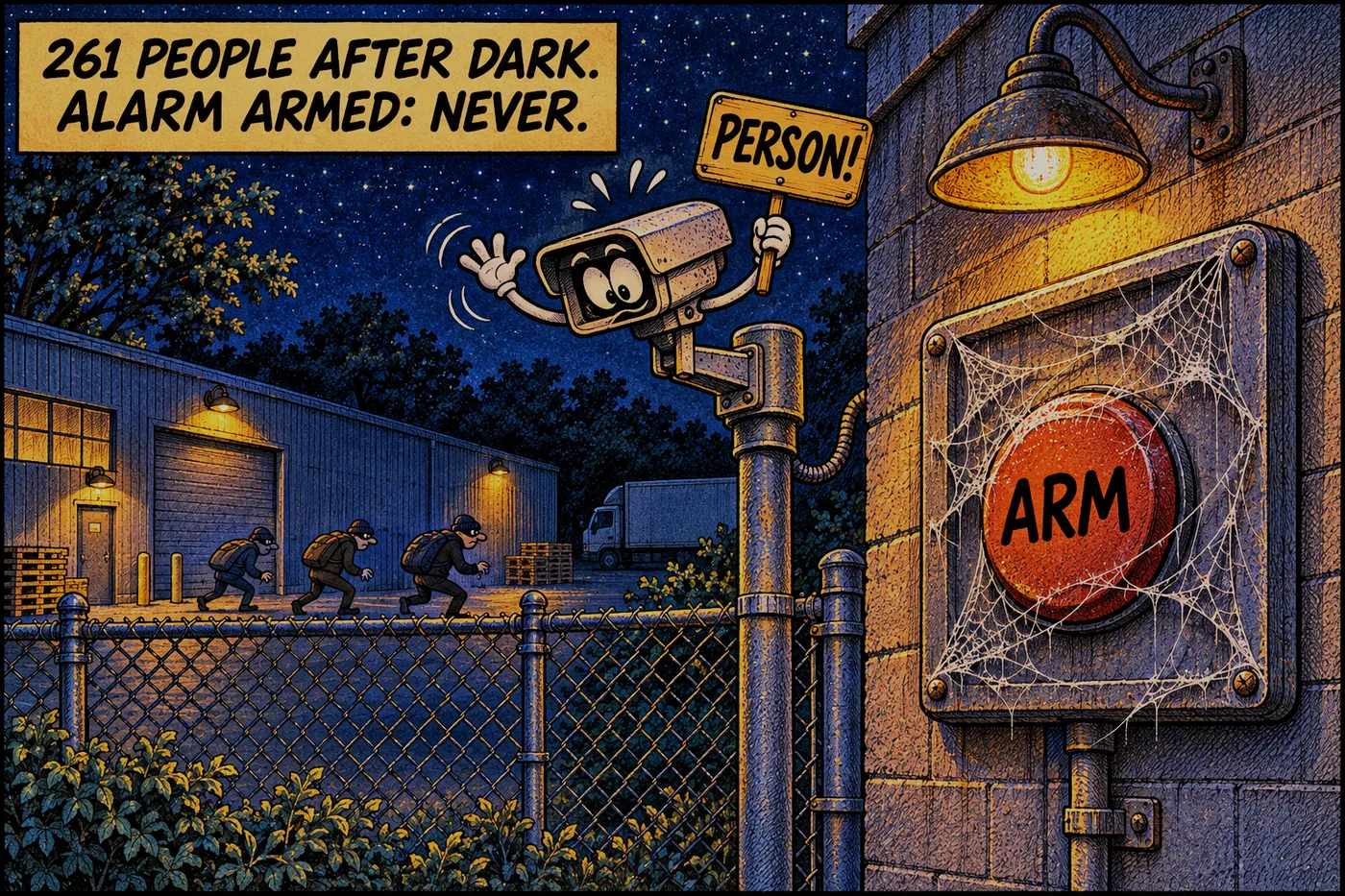
The camera was doing its best.
Then came the break-ins. Not one. Several.
Some of them hit a part of the property that didn’t have any equipment yet, because that building didn’t have power to run it. No setting on earth covers a building with nothing in it. But everywhere the system was installed, it sat there for months, fully capable of screaming its head off at every one of those after-dark visitors, and nobody ever turned it on. A siren and a phone alert at 2 AM is usually the end of a burglar’s evening. An alarm that’s never armed is just very expensive wall art.
And then I heard the line I knew was coming:
Nobody ever told me how to use it. Nobody sent me instructions. Nobody offered to show me.
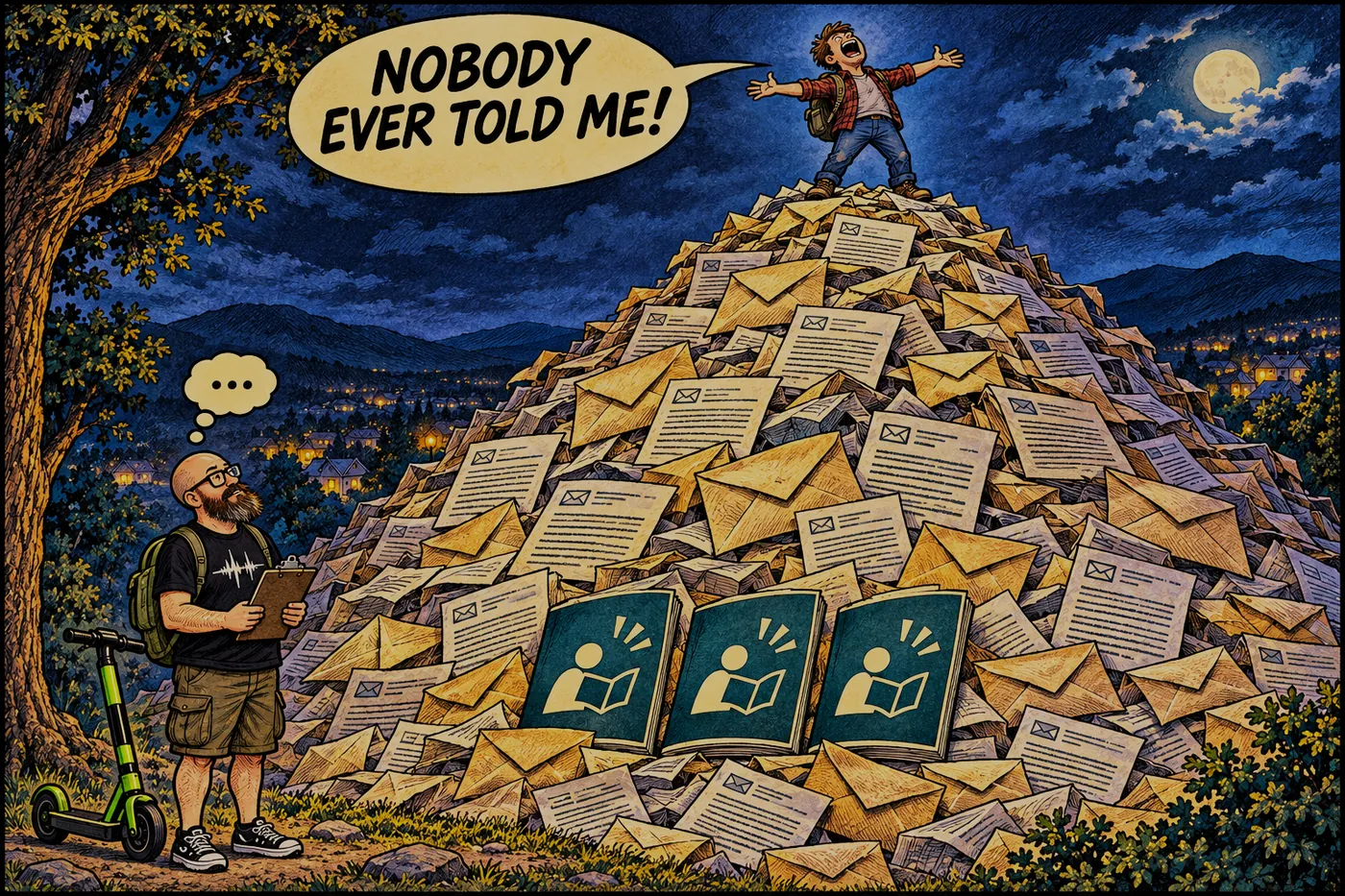
Standing on the instructions, asking where the instructions are.
Now picture all of that as phone calls.
Five months of “I told you on the phone” against “no you didn’t.” My memory against theirs. And remember Reason 3: my memory is a colander. I’d lose that argument even when I was right, because I’d have nothing to show.
Instead, I had everything. Dates, times, their own replies, the view counter. It took me about ten minutes to lay it all out.
In fairness
The record doesn’t take sides, so here’s the part that isn’t flattering to me. At one point an email from this client sat for six days before I answered it. That’s on me, and it’s in the timeline too, because I put it there.
And I get that some people learn better hands-on than from a guide. That’s exactly why I kept offering to come out. Offering wasn’t the problem. Saying yes was.
I’m not telling this story to dunk on one person. Most of my clients are great. I’m telling it because it’s the cleanest example I’ve ever had of why I do things the way I do.
What writing things down actually gets you
People sometimes act like texting and email is me protecting myself. It is. It’s also protecting you.
- You can reread it. At 2 AM, when the alarm is beeping and you forgot which button, the answer is sitting in your inbox.
- You can forward it. Your employee, your partner, the next IT guy. Nobody has to play telephone.
- It doesn’t depend on my ears. Or your connection, your background noise, or whether you were eating chips.
- It doesn’t depend on my memory. Or yours.
- It settles arguments in about ten seconds. For both of us. If I promised something and didn’t do it, the text proves that too.
What I’m not saying
- I’m not saying I won’t help you. I’ll help you faster in writing.
- I’m not saying I won’t come out. I do on-site visits all the time. I’d just like the plan in writing first.
- I’m not saying people are bad. Most people aren’t. But “most” isn’t “all,” and the ones who aren’t are exactly why the receipts exist.
So, how do you reach me?
Text me. Email me. Tell me what’s going on, send a photo if you’ve got one, and I’ll get back to you with an answer you can keep.
It’s not that I’m difficult. It’s that I’d rather be right, and have the receipts to show for it.
Not difficult. Documented.